
A balanced social casino economy gives players enough virtual currency and items to understand the game, make meaningful choices, and progress without making rewards feel unlimited or irrelevant. The practical goal is to control how quickly value enters, moves through, and leaves a closed play-money system in which rewards cannot be redeemed for money or real-world value.
Effective social casino virtual economy balancing requires four connected practices:
- Model every source, sink, reward, and availability constraint.
- Simulate progression across different player behaviors and session patterns.
- Review spending transparency, fairness, and behavioral guardrails.
- Operate economy parameters through version control, QA, analytics, and rollback plans.
The following process gives Economy Designers and Product Owners a repeatable way to evaluate those areas.
Model the economy system
Begin with a system map rather than isolated reward values. A reward that looks reasonable in one feature may become excessive when combined with login grants, missions, progression bonuses, events, and purchased virtual currency.
The model should show currencies, inventory items, progression requirements, acquisition routes, consumption points, and availability rules. It should also distinguish between guaranteed values and expected values from chance-based mechanics.
Rewards, sources and sinks
A source adds virtual value to a player’s account. A sink removes value or makes it unavailable for reuse. Rewards are the specific currencies, items, access rights, or progression benefits delivered by a source.
Typical sources can include:
- New-player grants
- Session or login rewards
- Missions and achievements
- Level-up rewards
- Collection completion
- Time-based bonuses
- Promotional grants
- Purchases of virtual currency or item bundles
- Compensation issued after technical problems
Typical sinks can include:
- Participation costs paid with play-money currency
- Consumable boosts
- Cosmetic or collection items
- Feature access
- Upgrade costs
- Refreshes or rerolls
- Time-limited convenience items
Document each flow in a common ledger:
| Economy element | Questions to record |
|---|---|
| Currency or item | Is it soft currency, premium currency, a consumable, a collectible, or an access entitlement? |
| Source | Which feature creates it, how often, and under what eligibility conditions? |
| Amount | Is the value fixed, variable, or chance-based? |
| Sink | Where can the value be used or removed? |
| Availability | Is it permanent, rotating, progression-gated, or time-limited? |
| Limits | Are there claim limits, inventory caps, cooldowns, or purchase restrictions? |
| Player communication | How are quantity, duration, eligibility, and use explained? |
For each player segment and simulation period, calculate:
Net economy change = total value created − total value consumed
A positive net change is not automatically a problem. Players may need reserves for future choices, and early progression often requires generous onboarding. The warning sign is persistent accumulation without meaningful uses. Conversely, a negative net change can be acceptable for an optional high-cost activity but harmful when it becomes the normal route through core progression.
Do not treat all assets as interchangeable. One unit of a broadly usable currency has different utility from a restricted item. Model conversion routes and substitution explicitly so that an apparently scarce reward cannot be bypassed through another source.
Segment behavior and purchasing options
An average-player model hides important failure cases. Segment players by behavior that changes economy outcomes, not by labels that merely describe them.
Useful analytical segments include:
- Session frequency and duration
- Feature participation
- Progression stage
- Reward-claim consistency
- Currency accumulation or depletion pattern
- Use of optional purchases
- Preference for saving versus immediate spending
- Responsiveness to collections, customization, or convenience items
Maintain non-purchasing paths in every progression simulation. The model should show whether a player who makes no purchases can understand the system, participate in the core experience, recover from low balances, and continue progressing at the intended rate.
Purchasing scenarios should be modeled as optional branches rather than the default baseline. Record what each option provides, how long its utility may last, which limits apply, and whether it creates downstream economy effects. For example, a bundle containing currency plus consumables must be evaluated as two sources, not as one headline offer.
Segment models should also identify concentration risk. If one small behavior group generates or consumes a disproportionate share of virtual value, changes made for that group may destabilize the experience for everyone else. Use separate parameters or eligibility rules only when they remain understandable, testable, and fair.
Simulate player progression
A static spreadsheet cannot reveal whether the economy works across weeks of play. Progression simulation connects reward frequency, session behavior, item availability, and sink demand over time.
Use both deterministic scenarios and probability-based simulations. Deterministic cases make assumptions easy to inspect; probabilistic models reveal the range of possible outcomes around those assumptions.
Session scenarios and reward accumulation
Build scenarios around realistic actions rather than a single daily average. At minimum, model new, progressing, highly engaged, returning, and low-balance players. Every scenario should state its assumptions clearly.
A progression simulation can follow this sequence:
- Set the starting state. Record balances, inventory, progression level, unlocked features, and outstanding rewards.
- Define session behavior. Specify session frequency, activities selected, expected participation costs, reward claims, and item use.
- Apply source rules. Add guaranteed rewards and sample variable rewards according to their configured distributions.
- Apply sink rules. Deduct costs only when the scenario meets the relevant participation or purchase conditions.
- Advance progression. Unlock new sources, sinks, and items according to the progression model.
- Track the closing state. Record balances, inventory, access, unmet goals, and the next available action.
- Repeat across the review horizon. Compare daily, weekly, and longer-term trends rather than relying on one session.
- Run sensitivity tests. Change claim rates, session frequency, reward variance, and sink participation to identify fragile assumptions.
Track more than the final balance. Useful outputs include:
- Time required to reach key progression points
- Percentage of sessions ending with very low balances
- Frequency and duration of blocked states
- Unused inventory growth
- Source-to-sink ratio by currency
- Median and outlier accumulation
- Availability of meaningful choices at each stage
- Dependence on a single reward source
- Recovery time after resource depletion
Expected-value calculations are useful for forecasting, but they can conceal poor individual outcomes. Two players may receive the same expected value while experiencing very different reward sequences. Examine percentiles and adverse sequences, especially when virtual rewards affect access to core play.
Detecting inflation or dead ends
Economy inflation occurs when virtual value enters the system faster than players can or want to use it, reducing the relevance of rewards and prices. A progression dead end occurs when a player lacks a reasonable route to the resources or access needed for continued core play.
Potential inflation signals include:
- Balances rising across successive progression stages
- Reward claims losing relevance
- Sinks used only by a narrow segment
- Frequent price increases needed to preserve item significance
- Large inventories of unused consumables
- New grants overshadowing previously earned value
Potential dead-end signals include:
- Repeated low-balance sessions with no clear recovery route
- Progression requirements increasing faster than earning capacity
- Essential items appearing too rarely
- A single missed claim causing prolonged disadvantage
- Core choices disappearing at predictable progression points
- Optional purchasing becoming the only practical way forward
Investigate the system cause before changing a headline reward. Inflation might result from an overlooked source, weak item utility, or poor sink timing. A dead end may come from reward variance, unclear eligibility, or an unlock sequence rather than insufficient total value.
Use bounded adjustment rules. For example, define acceptable balance ranges and progression windows by segment, then identify which source or sink is allowed to change when results fall outside those ranges. This is safer than repeatedly altering multiple parameters until a dashboard improves.
Review behavioral guardrails
Mathematical balance does not guarantee responsible design. The economy must also communicate virtual value clearly, preserve meaningful choices, and avoid mechanics that pressure or confuse players.
Treat behavioral review as a release requirement, not a final copy check.
Spending transparency and fairness
Players should be able to understand what they receive, what an action costs, and whether an item expires or has restricted use. This applies to both earned and purchased virtual goods.
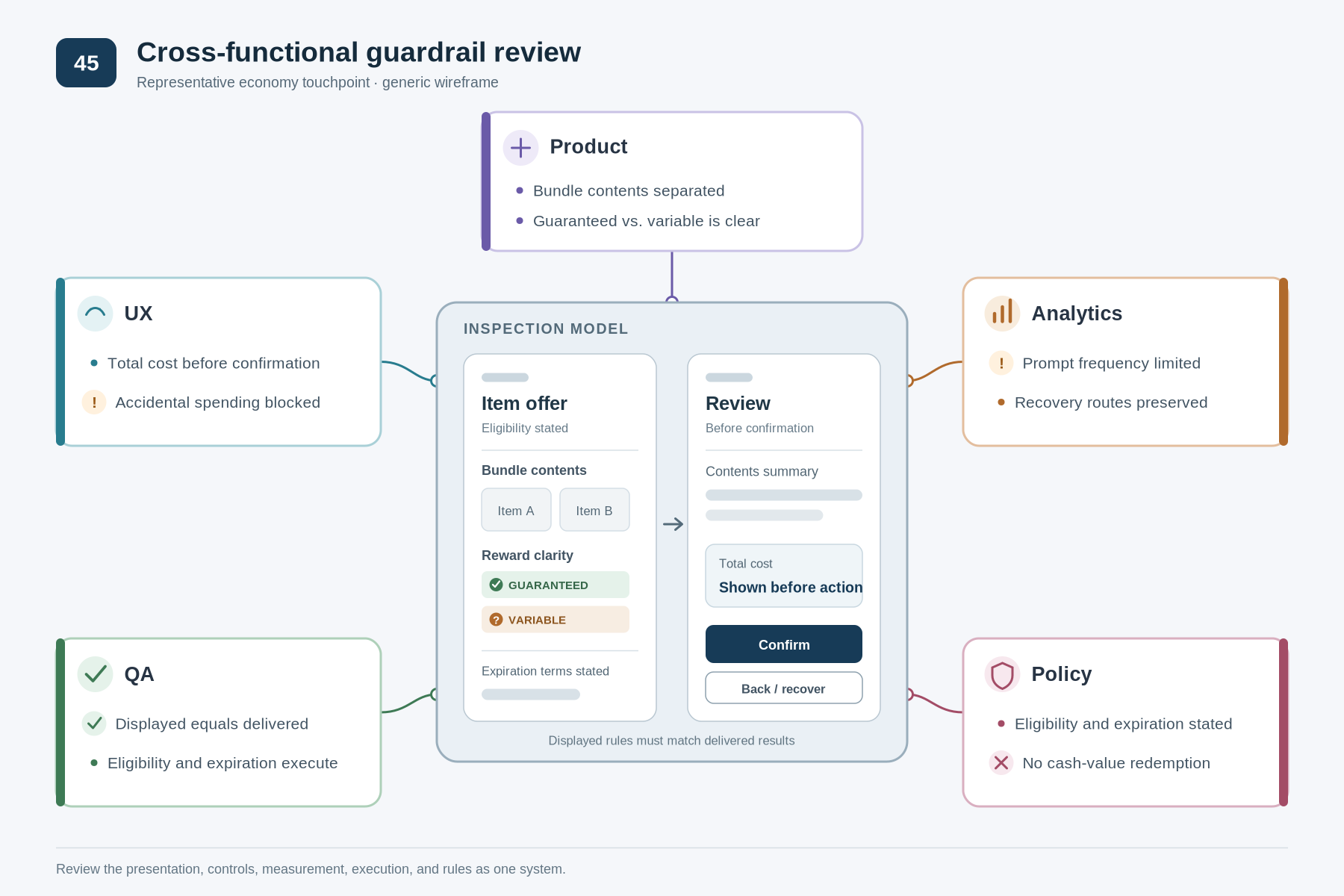
Review each economy touchpoint for:
- Clear quantities and currency names
- Consistent icons, colors, and terminology
- Total cost shown before confirmation
- Bundle contents listed separately
- Expiration or availability conditions
- Eligibility and claim limits
- Distinction between guaranteed and variable rewards
- Confirmation for consequential uses of premium virtual currency
- Accessible balance and transaction feedback
- A way to recover from accidental navigation without unintended spending
Fairness also requires consistent rule execution. Two visually identical offers or rewards should not behave differently without an explained reason. If eligibility changes by progression stage or segment, QA must verify both the displayed message and the delivered contents.
Use plain language to state that currencies and rewards are for play within the game and have no cash value or real-value redemption. Product teams should also review the current Google Play policy on real-money gambling, games, and contests when evaluating store presentation, gameplay framing, advertising, and regional distribution. Policy review should use the current official text rather than assumptions carried over from earlier releases.
Avoiding exploitative design patterns
A responsible economy should not depend on distress, confusion, or loss of control to create engagement. Review both individual mechanics and the cumulative pressure created when several prompts appear together.
Flag designs that:
- Obscure the total virtual cost of an action
- Introduce unexpected costs after a player has committed time
- Use misleading urgency or unclear countdowns
- Make essential information difficult to dismiss or revisit
- Turn repeated failure into escalating purchase pressure
- Exploit accidental taps or ambiguous button hierarchy
- Use near-miss presentation to misrepresent outcomes
- Make reward eligibility or availability intentionally difficult to understand
- Remove reasonable recovery routes after resource depletion
Guardrails should be expressed as testable product requirements. “Avoid pressure” is subjective; “do not show a purchase prompt immediately after every low-balance outcome” can be verified. Likewise, define limits on prompt frequency, specify when confirmation is required, and document which information must remain visible before a player spends virtual currency.
Include UX, analytics, QA, product, and policy stakeholders in this review. Economy parameters influence behavior, but presentation and interaction design determine how players interpret those parameters.
Operate a balancing process
Balancing is an operational discipline rather than a one-time spreadsheet exercise. Every economy change should connect a hypothesis, parameter version, QA record, measurement plan, and reversal path.
Separate configurable values from application logic where practical, but apply the same release controls to both.
Versioned parameters and QA
Maintain a parameter registry with one authoritative definition for each configurable value. The registry should identify:
| Field | Purpose |
|---|---|
| Parameter ID | Stable identifier used across configuration, analytics, and QA |
| Current value | Production setting and unit |
| Scope | Feature, progression range, segment, platform, or region affected |
| Effective period | Start and end conditions |
| Dependency | Other parameters or features influenced by the value |
| Change owner | Person accountable for approval |
| Rationale | Problem, evidence, and expected outcome |
| Version | Release or configuration version |
| Rollback value | Previously validated setting |
| Validation status | Simulation, QA, analytics, and policy checks completed |
Use a controlled release procedure:
- Define the economy problem and target metric.
- Identify the smallest parameter set capable of addressing it.
- Re-run progression and edge-case simulations.
- Review transparency and behavioral guardrails.
- Test grants, deductions, limits, expiration, and eligibility.
- Verify analytics events against the parameter version.
- Approve the release and rollback thresholds.
- Monitor outcomes before expanding exposure.
QA should cover boundary values, interrupted transactions, duplicate claims, delayed delivery, account restoration, clock changes, and configuration mismatches. It should also reconcile the displayed amount, server-authoritative result, balance history, and analytics event.
Dashboards, experiments and rollback
Economy dashboards should explain flows, not merely report revenue or aggregate balances. Break metrics down by progression stage and behavioral segment so that opposing trends do not cancel each other out.
A practical dashboard includes:
- Currency created and consumed by source and sink
- Net balance change and balance distribution
- Item acquisition and use
- Low-balance frequency and recovery time
- Progression velocity
- Reward claim and expiration rates
- Purchase-option exposure, selection, and delivery
- Error, duplication, and reconciliation rates
- Parameter version and release cohort
Experiments should test a specific causal hypothesis. Change as few connected values as possible, define primary and guardrail metrics in advance, and examine distributional effects. An improvement in average progression is not acceptable if it creates severe dead ends for a meaningful subgroup or increases confusing spending interactions.
Rollback criteria should be measurable. Examples include abnormal resource creation, delivery errors, sharp growth in blocked sessions, or a guardrail metric moving beyond its approved range. Preserve the previous configuration, verify that rollback itself is safe, and document how balances or items affected during the test will be handled consistently.
Virtual-economy balancing review worksheet
Use this checklist before approving an economy change:
- [ ] Every reward, currency, item, source, sink, and conversion route is mapped.
- [ ] Guaranteed and variable reward values are modeled separately.
- [ ] Non-purchasing progression remains viable.
- [ ] Multiple session and behavior scenarios have been simulated.
- [ ] Balance distributions and adverse sequences have been reviewed.
- [ ] Inflation, depletion, dead ends, and recovery routes have explicit thresholds.
- [ ] Costs, contents, limits, and expiration conditions are clearly presented.
- [ ] Virtual rewards are described as having no cash value or real-value redemption.
- [ ] Behavioral guardrails are written as testable requirements.
- [ ] Parameters, assumptions, dependencies, and owners are versioned.
- [ ] QA reconciles interface, server state, balance history, and analytics.
- [ ] Dashboards identify the active parameter version.
- [ ] Experiment success and rollback criteria are approved before release.
- [ ] Current platform policy requirements have been reviewed.
For an independent review of progression models, economy parameters, instrumentation, and guardrails, request an economy design assessment.