
Google Play screenshots for social casino apps should explain what players actually do, why the experience is enjoyable and which features distinguish the game. A strong sequence is not a gallery of attractive screens. It is a six-frame visual story that moves from the core value proposition to representative gameplay, progression and social features.
For ASO managers and creative leads, the practical objective is to make every frame truthful, readable and useful at listing scale. The following storyboard and production checks apply to poker, blackjack, bingo, roulette and slot-style apps, with adjustments for each genre.
Create a screenshot story
Plan the sequence before polishing individual images. Each frame should answer a different player question, while the complete set should communicate a coherent experience without requiring the viewer to read the full description.
A six-frame storyboard provides a useful production baseline:
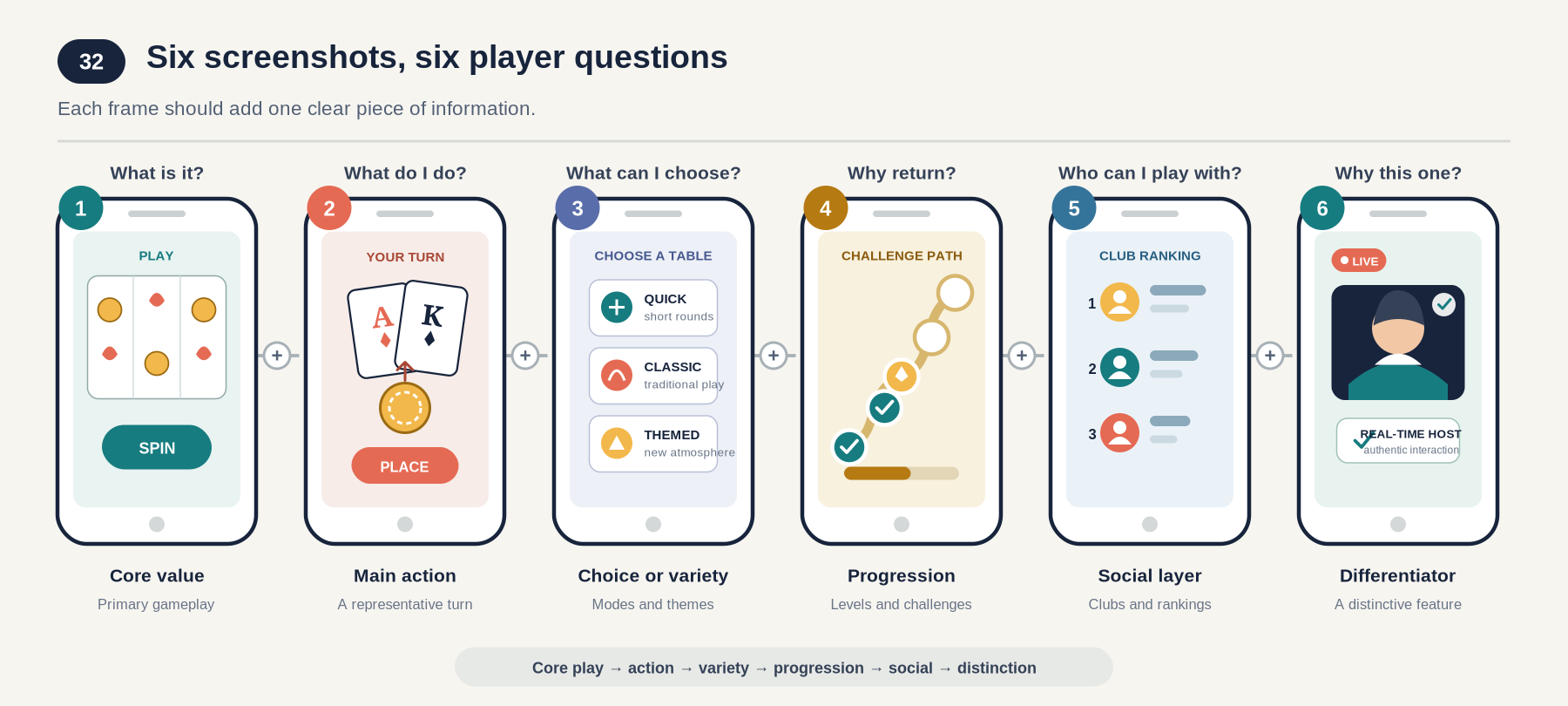
| Frame | Player question | Visual focus | Caption purpose |
|---|---|---|---|
| 1. Core value | What kind of game is this? | Recognizable primary gameplay | State the main experience clearly |
| 2. Main action | What will I do? | A representative turn, round or interaction | Explain the central mechanic |
| 3. Choice or variety | What can I explore? | Modes, tables, rooms, cards or themes | Show meaningful range |
| 4. Progression | Why should I return? | Collections, levels, challenges or rewards | Present an authentic retention feature |
| 5. Social layer | Can I play or interact with others? | Clubs, tables, leaderboards or multiplayer elements | Clarify the social value |
| 6. Differentiator | Why choose this app? | The strongest distinctive feature not yet shown | End with a credible reason to install |
This is a creative framework, not a requirement to force six unrelated features into the listing. If an app has no social system, for example, replace the fifth frame with another real source of value rather than implying that one exists.
Opening image and core value
The opening screenshot has the most demanding job: it must establish genre, gameplay and value almost immediately. Use a screen that a prospective player can identify without decoding a complicated interface.
An effective first frame usually contains:
- a recognizable game state, such as an active poker table or bingo card;
- one short, specific caption;
- a clear focal point;
- enough authentic interface to establish that the image represents gameplay;
- visual hierarchy that still works when the screenshot appears small.
Prefer concrete captions such as “Join fast poker tables” or “Play themed bingo rooms” when those claims accurately describe the app. Broad statements such as “The ultimate casino experience” provide little information and can obscure the product itself.
Avoid turning the opening frame into a poster with minimal connection to the interface. Character art and decorative effects can support the composition, but they should not make the actual game difficult to identify. A viewer should not have to reach the third screenshot to learn whether the app is poker, bingo or slots.
Game feature sequence and visual clarity
Frames two through six should add information rather than restating the opening claim. Assign one message to each frame and select the gameplay state that demonstrates it most directly.
Use this production process:
- Inventory real features. List the mechanics, modes, progression systems and social functions available in the current app.
- Prioritize player value. Rank features by importance to the intended audience, not by which screen is easiest to decorate.
- Map one idea to each frame. Give every screenshot a distinct communication task.
- Capture representative states. Use gameplay that a normal player could encounter, with plausible interface and progression conditions.
- Add concise captions. Make text complementary to the image rather than a substitute for it.
- Review the sequence at listing size. Check whether the story remains understandable when frames are viewed quickly or only partially.
Keep primary interface elements away from areas likely to be obscured by decorative borders, device crops or caption panels. Do not place essential cards, controls, numbers or status information at the extreme edges. Review the exported creative—not only the design file—because cropping and scaling can alter the hierarchy.
Adapt by genre
The same storyboard logic applies across casino-style categories, but the evidence of value differs. A poker screenshot needs to communicate table context and decisions; a slot-style image needs to make the reel layout and feature state understandable.
Poker tables and social play
Poker creatives should preserve the table as the visual anchor. Cards, player positions, action controls and the current game state need enough space to remain legible. Excessive effects can make a real table look like a generic casino scene.
Useful frames may show:
- a clear table view with the relevant poker format visible;
- a decision point that represents normal play;
- table or room selection, if it is a meaningful feature;
- clubs, friend functions or social tables that genuinely exist;
- tournaments or scheduled modes presented with accurate availability;
- customization or collection systems connected to the player experience.
If social play is the differentiator, show how it appears in the product. A club interface, multiplayer table or supported social interaction is stronger evidence than a caption claiming “Play with friends” over unrelated gameplay.
Captions should not cover cards, bet controls or player information needed to understand the scene. When the table contains many small elements, reduce decorative copy and allow the interface to carry more of the message.
Blackjack, roulette and slot-style mechanics
For blackjack, choose a state in which the dealer, player hand and available actions are visually distinct. A screenshot should make the core decision loop understandable rather than presenting a crowded result screen with no context.
Roulette creatives benefit from showing the relationship between the betting layout and wheel-based outcome. If both cannot remain legible in one frame, use separate screenshots with separate messages instead of shrinking everything into a single composition.
Slot-style screenshots should retain the reel grid, symbols and relevant feature state. When highlighting bonus rounds or special mechanics, confirm that the captured state is available in the released product and is not presented as the default experience if it occurs only under specific conditions.
For bingo, prioritize card readability, called-number context and room or event identity. Collections, themes and multiplayer rooms can support later frames, but the sequence should first make the marking or matching experience recognizable.
Across these genres, avoid using coins, chips, celebratory effects or prize imagery as visual filler. Every prominent element should accurately reflect the app’s mechanics, economy and positioning.
Keep creatives accurate
Accuracy is both a production standard and a conversion consideration. A polished screenshot can create the wrong expectation if its interface, feature state or caption no longer matches the current app.
Real gameplay, readable captions and translations
Build creatives from approved, current captures. If the design team recomposes interface elements for clarity, the result should still represent the actual visual system and available gameplay.
Use this visual QA checklist before delivery:
- The depicted feature exists in the version being promoted.
- Controls, cards, symbols and game states are internally consistent.
- Captions describe what the screenshot demonstrates.
- Text remains readable at reduced listing size.
- Caption contrast works across light and dark backgrounds.
- Decorative elements do not resemble unavailable controls.
- Legal or qualifying text, when required, is legible.
- Currency, terminology and number formats suit the target market.
- Translations fit without forced compression or awkward line breaks.
- Localized text has been reviewed in the context of the final image.
Do not simply replace English copy in a fixed text box. Translated captions can expand, wrap differently or change emphasis. Rebalance the composition for each language while preserving the same message and gameplay evidence.
A useful review method is to hide the caption and ask what the image communicates on its own. Then hide the gameplay and read the caption independently. If the two parts suggest different features, revise the frame.
Policy and device-format review
Casino-style apps require careful classification and policy review because requirements can depend on the app’s mechanics, target markets, age controls and distribution model. Social casino presentation should not be assumed to follow the same rules as real-money gambling, nor should visual language imply functionality the app does not provide.
Before publishing, verify the current:
- Google Play store-listing requirements;
- applicable age-rating and audience settings;
- gambling, games and contests rules;
- privacy disclosures and related listing information;
- country or region distribution restrictions;
- device-specific screenshot specifications and accepted formats.
Consult Google’s current Gambling, Games and Contests policy and the relevant Play Console guidance during final review. Policies and listing requirements can change, so do not rely on a previous campaign’s approval as confirmation for a new release.
Export and inspect each supported device format separately. A composition that works on a tall phone screenshot may fail when adapted to another aspect ratio. Preserve the information hierarchy rather than stretching one master file. Check captions, interface scale, edge clearance, crops and sequence order in the final listing preview.
Measure creative effectiveness
Screenshot performance should be evaluated against a defined communication hypothesis. The goal is to learn whether a particular visual story helps qualified visitors understand the app—not merely whether a more dramatic design attracts attention.
Hypotheses and test variants
Write one hypothesis for each proposed screenshot change. Keep the variable narrow enough to interpret.
Examples include:
- Leading with active gameplay will communicate the genre more clearly than leading with character artwork.
- Showing a social poker table earlier will better convey multiplayer value.
- Replacing a general quality claim with a mechanic-specific caption will improve feature comprehension.
- Using a localized bingo-room frame will be more relevant to visitors in that market.
- Enlarging the central game area will improve readability without removing essential context.
Variants should remain accurate and policy-reviewed. Record the frame order, caption, source capture, localization and device format so that performance can be connected to a specific creative decision. This is screenshot-level testing, not a substitute for a broader listing experimentation strategy.
Listing performance by market
Review creative results by relevant market and device context rather than assuming one sequence performs consistently everywhere. Language, genre familiarity, feature availability and visual conventions can change how visitors interpret the same frame.
Track the listing indicators available to your team alongside release timing and other material changes. Compare like with like: the same market, comparable traffic conditions and the intended device format. Do not attribute every movement to screenshots when the app, acquisition mix, rating profile or listing copy changed at the same time.
Use findings to improve the storyboard:
- Move clearly understood value earlier.
- Replace frames that duplicate the same message.
- Rewrite captions that require too much interpretation.
- Adapt genre emphasis by market where the product supports it.
- Retain accurate gameplay evidence even when exploring bolder presentation.
A disciplined six-frame sequence gives creative teams a shared production plan and gives ASO managers testable messages. If your current assets need a structured review for storytelling, readability, localization, format and policy readiness, request a store-creative review through our Google Play ASO service.