
The right paid channel for a social casino app is one on which the product, advertiser, target country, audience, creative and destination are all eligible at the same time.
For publishers and Growth Leads, this makes channel selection a policy qualification process. Before launching, create a country-by-channel matrix, record required certifications or approvals, and define when campaigns must stop. Treat any unresolved combination as unavailable—not as permission to test.
This framework covers virtual or play-money social casino gameplay. It does not cover products offering cash prizes, withdrawals or access to real-money betting.
Create a policy-qualified channel shortlist
Begin with channels that appear capable of accepting the product. Do not build campaign plans around a network until its current rules have been checked for the intended country, platform and destination.
A channel passes the initial screen only when:
- The product is classified correctly.
- Advertising is permitted in the target country.
- The intended age group is eligible.
- The advertiser and account meet approval requirements.
- The ad format and creative comply with channel rules.
- The app store listing or landing page is acceptable.
- Any required certification is active before launch.
Qualification must happen independently for each channel. Approval from an app store, another advertising platform or a previous campaign does not establish eligibility elsewhere.
Social casino and real-money classification boundaries
Social casino apps simulate casino-style gameplay using virtual or play-money mechanics. Their paid media review can be stricter than review for a conventional mobile game because their themes, terminology and mechanics resemble regulated gambling products.
Create a written product-classification summary before approaching media platforms. It should identify:
- The game’s core loop and casino-style mechanics.
- The function of virtual currency.
- Whether virtual items can be redeemed, transferred or withdrawn.
- Whether players can win money or anything else of real-world value.
- Whether the app contains links, promotions or pathways to real-money gambling.
- The intended minimum audience age.
- Every website, app store page and legal entity associated with the campaign.
The summary must match the live product. A “social casino” label does not resolve contradictory mechanics, promotional claims or destination content.
For this framework, a qualifying product must remain within virtual or play-money gameplay. If a product offers or implies cash prizes, withdrawals, real-value rewards or links to real-money betting, stop the social casino assessment and obtain a separate classification. Do not attempt to resolve the conflict through creative wording.
The same boundary must be visible across the user journey. Ad text, videos, screenshots, store descriptions, age ratings and landing pages should not suggest that users can make money, cash out winnings or transition to real-money gambling.
Market, age and destination eligibility by channel
Assess a channel as a combination of variables rather than assigning it one global status.
| Eligibility dimension | Question to answer | Evidence to retain |
|---|---|---|
| Product | Does the channel accept this type of social casino app? | Current policy text and internal classification |
| Country | Is social casino promotion allowed in the target market? | Country-specific policy or written platform confirmation |
| Age | What minimum age and targeting controls apply? | Policy requirement and campaign settings |
| Advertiser | Does the legal entity qualify to advertise? | Account details, ownership records and approvals |
| Certification | Is prior platform certification required? | Active certification or approval record |
| Creative | Are casino imagery, terminology and claims permitted? | Approved assets and review results |
| Destination | Is the app store page or landing page eligible? | Live URL, store listing and policy review |
| Format | Are the intended placements and formats allowed? | Placement-level policy check |
A market being generally available on an ad platform does not mean social casino promotion is permitted there. An eligible country may still have age, account, placement or destination restrictions.
Record eligibility for the precise destination type. A website campaign, Android app campaign and iOS app campaign can produce different outcomes because their destinations, store policies and user journeys differ.
Compare paid acquisition environments
Compare paid acquisition environments on policy fit before reach, optimization features or creative formats. The objective is to identify where a compliant campaign can exist—not to assume that every major network belongs in the channel mix.
Capture four layers:
- Published policy: What the platform explicitly allows or restricts.
- Market eligibility: Where the product may be promoted.
- Advertiser approval: Which certifications, permissions or account reviews apply.
- Campaign review: Whether the specific creative, destination and targeting setup is approved.
Published eligibility is necessary but not sufficient. Individual campaigns and assets may still be rejected or restricted during review.
Google Ads certification and allowed geographies
Google Ads treats social casino game advertising as a restricted category. Eligible advertisers must obtain Google Ads certification, and promotion is limited to approved countries. Certification does not create worldwide permission or override campaign-level restrictions.
Before including Google Ads in the shortlist, confirm:
- The app fits Google’s social casino definition.
- The advertiser is eligible for certification.
- Certification covers the relevant account and product.
- Each target country appears in the current eligible geography list.
- Campaign targeting complies with applicable age restrictions.
- Creative does not imply real-money gambling or prizes of real-world value.
- The destination does not offer or link to real-money gambling.
- The account, domain, app and legal entity are consistent with the approval.
Consult the current Google Ads gambling and games policy for social casino games before planning and again before launch. Country availability and restrictions can change, so a previously approved market is not permanently eligible.
Google Play distribution is a separate control layer. Review the current Google Play policy on gambling, games and contests for store eligibility and content requirements. Google Play availability is not automatic authorization to advertise through Google Ads.
Keep these decisions separate:
| Decision | Controlling review | What it establishes |
|---|---|---|
| App may be distributed | Applicable app store | Store eligibility under store rules |
| Advertiser may promote social casino games | Google Ads certification | Advertiser eligibility under the restricted-category policy |
| Country may be targeted | Current Google Ads geography rules | Market-level advertising eligibility |
| Campaign may run | Account and ad review | Approval of the submitted campaign configuration |
Other networks: separate platform restrictions and review status
Do not transfer Google Ads eligibility to another network. Social platforms, search products, app-store advertising products, programmatic platforms and mobile ad networks apply their own definitions and restrictions.
Assess each environment separately:
| Paid environment | Primary qualification question | Review record needed |
|---|---|---|
| Social advertising platform | Does its restricted-content policy permit social casino promotion in the target country? | Policy version, market status and account review |
| App-store advertising product | Is the app and category eligible for paid placement in that storefront? | Storefront, country and app approval |
| Programmatic demand-side platform | Do the platform and selected inventory permit the category? | Platform approval and supply restrictions |
| Mobile ad network | Are the app, creative and destination accepted for each market? | Written approval or dashboard review status |
| Search or display platform | Does simulated gambling require certification or restricted targeting? | Certification status and campaign decision |
If a public policy does not clearly address social casino games, mark the platform not assessed until it provides an authoritative answer. Silence is not approval.
Where an agency, reseller or managed-service partner operates the account, establish which party is responsible for classification and approval. An intermediary’s willingness to submit campaigns does not replace the platform rules.
Document approval and account requirements
Policy qualification must be auditable. Store screenshots, approval emails and policy links with dates, account identifiers and responsible owners. This prevents launch decisions from relying on memory or informal assurances.
Use one approval record per platform and legal advertiser. Record:
- Advertising platform and account ID.
- Advertiser’s legal entity.
- App name, package or store identifier, and website domain.
- Product-classification summary.
- Certification or restricted-category approval status.
- Approved and excluded countries.
- Minimum age and targeting requirements.
- Approved destination URLs.
- Creative restrictions.
- Date checked and next review date.
- Internal owner and escalation contact.
Proof of eligibility and advertiser ownership
Platforms may need to confirm that the advertiser has a legitimate relationship with the app, account and destination. Prepare consistent ownership evidence before submission.
The evidence pack should include, where relevant:
- Legal business name and contact details.
- Advertising account ownership or authorized access.
- Developer or publisher identity shown on the store listing.
- App identifiers and official product URLs.
- Domain ownership or authorization.
- Current privacy policy and terms.
- Restricted-category approval or certification records.
- Written authorization for agencies or external account operators.
Avoid unexplained differences between the certified advertiser, billing entity, developer name, domain owner and campaign account. Legitimate differences should be documented rather than left for a reviewer to infer.
Attach approval to the correct operational account. A decision concerning one account, app or domain should not automatically be reused for another entity or new account.
Landing-page and store listing consistency
Reviewers assess more than the ad. The destination and surrounding product presentation can determine campaign eligibility.
Run a consistency check across:
- Ad headlines and body copy.
- Video, audio and static creative.
- Calls to action.
- App name and icon.
- Store screenshots and preview videos.
- Store description and promotional text.
- Website landing pages.
- Age rating and audience settings.
- Terms, privacy disclosures and support pages.
Describe the product consistently as virtual or play-money entertainment. Remove or escalate language that implies earning, winning or withdrawing money. Check whether visual elements, buttons or linked pages create an apparent route to real-money gambling.
A destination change should trigger reassessment. Examples include adding a landing page, changing the store description, introducing a web version, altering virtual-currency explanations or adding external links.
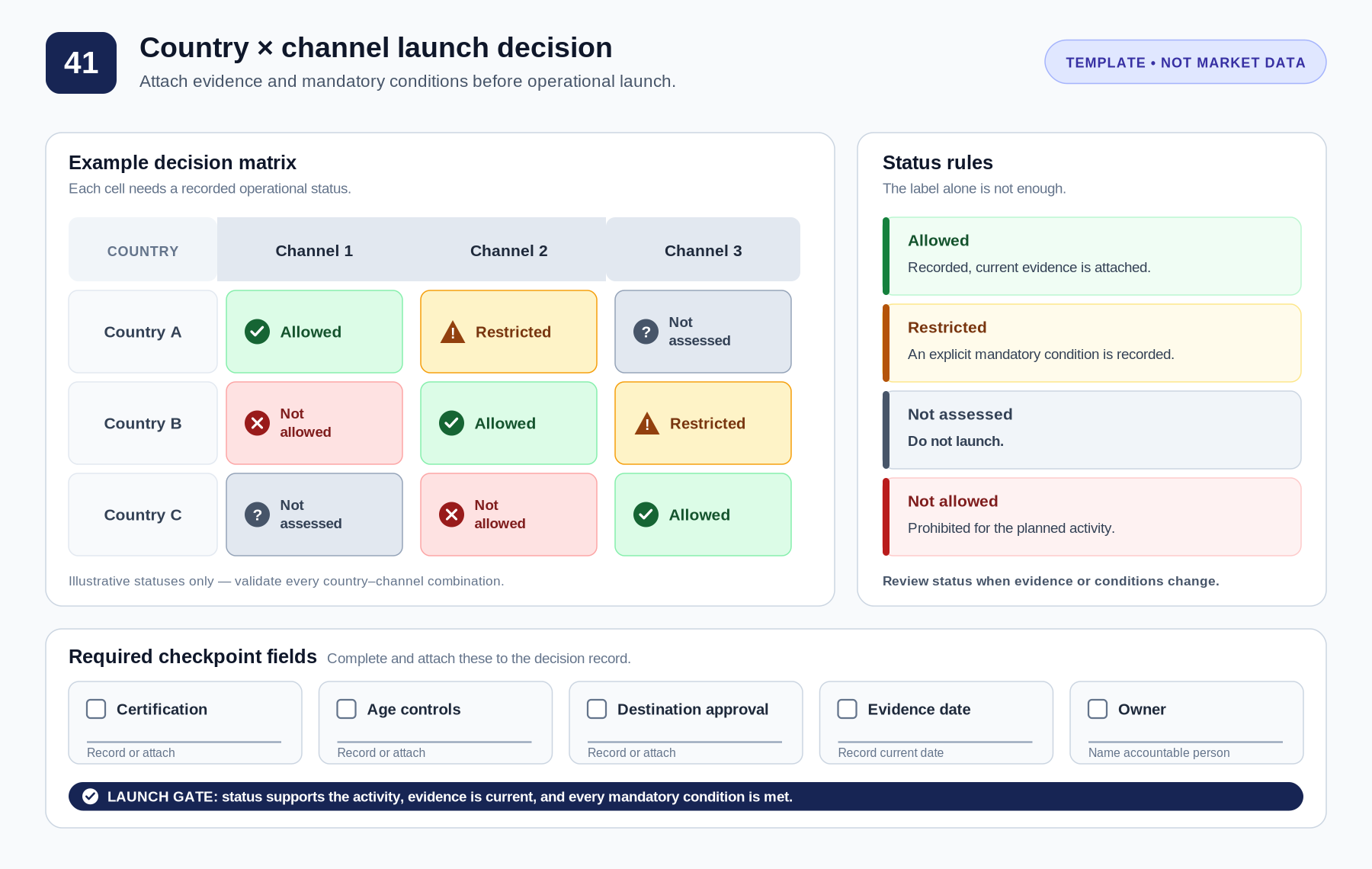
Build the channel decision matrix
The decision matrix is the operating record for social casino paid user acquisition channels. Maintain it at country level because platform-wide labels such as “approved” or “restricted” are too broad for launch decisions.
Create a row for every intended country and a column for every candidate channel. Include mandatory checkpoint columns rather than storing certifications in a separate document.
Allowed / restricted / not assessed by country
Use four statuses:
- Allowed: Current evidence confirms that the product, advertiser, country and destination meet the channel’s requirements.
- Restricted: Promotion may be possible only under documented conditions, such as certification, age controls, limited placements or approved destinations.
- Not assessed: Current eligibility has not been established. No campaign may launch.
- Not allowed: Current policy or a platform decision prohibits the planned activity.
Use this country-by-channel matrix in the campaign approval record:
| Country | Google Ads | Social platform | App-store ads | DSP/ad network | Certification complete? | Age controls confirmed? | Destination approved? | Evidence date | Owner |
|---|---|---|---|---|---|---|---|---|---|
| Country 1 | Not assessed | Not assessed | Not assessed | Not assessed | No | No | No | — | Growth Lead |
| Country 2 | Not assessed | Not assessed | Not assessed | Not assessed | No | No | No | — | Growth Lead |
| Country 3 | Not assessed | Not assessed | Not assessed | Not assessed | No | No | No | — | Growth Lead |
Replace generic channel headings with actual platform names. Do not change a cell to Allowed until its evidence is recorded.
For restricted combinations, add the exact condition:
| Country | Channel | Status | Mandatory condition | Evidence | Launch decision |
|---|---|---|---|---|---|
| Selected market | Selected platform | Restricted | Certification plus applicable age targeting | Policy link and approval record | Hold until complete |
| Selected market | Selected platform | Allowed | Approved app destination only | Review confirmation | Eligible for approved setup |
| Selected market | Selected platform | Not assessed | Written classification required | Pending | Do not launch |
This prevents conditional permission from being mistaken for unrestricted eligibility.
Periodic checks, stop rules and escalation
Policy compliance is not a one-time launch task. Define a recheck cadence based on risk and campaign changes. At minimum, recheck before entering a new country, using a new channel, changing the destination or launching materially different creative.
Stop or pause affected campaigns when:
- Required certification expires, is withdrawn or no longer matches the account.
- A country is removed from an eligible-market list.
- The platform changes its social casino classification or advertising rules.
- Required age targeting cannot be applied.
- The app, website or store listing introduces conflicting claims.
- A campaign serves outside approved geographies or placements.
- The advertiser, developer, domain or account ownership changes.
- Ads are rejected for a potentially product-level policy reason.
- The destination links to real-money betting or implies cash-out functionality.
- The team cannot produce current evidence supporting an Allowed status.
Escalation should have a named owner, a documented question and a clear release condition. Keep the campaign paused while eligibility remains ambiguous. Repeatedly resubmitting substantially unchanged ads is not a substitute for resolving the underlying classification or account issue.
A strong channel plan starts with a defensible product classification, country-specific platform checks, completed certifications, consistent destinations and explicit stop rules. Once those controls are established, the Growth Lead can compare only the channels genuinely available.
Discuss a compliant channel plan for your social casino app and target markets.