
An Android roulette-style game should be scoped as a complete play-money product rather than only a spinning wheel and board. The product brief must define the table variant, supported selections, chip interactions, outcome logic, animation sequence, virtual balance, saved state and release checks.
For a focused first release, a practical scope includes:
- One single-player simulated table variant
- A portrait or landscape layout selected during UX planning
- Clearly selectable virtual chips
- Supported inside and outside board positions
- Rule-driven outcome evaluation
- Wheel, ball and result animations
- Local progress and virtual-balance saves
- A guided first session
- Roulette-specific telemetry
- Accessibility, screen-size and policy review
This blueprint gives Product Owners and studios an estimable brief for roulette game development on Android while keeping the experience entirely virtual and play-money.
Select a roulette experience
The table format determines the board layout, rule engine, tutorial content, visual assets and test coverage. Choose the initial variant before estimating development because supporting another layout affects more than the table artwork.
The product definition should answer four questions:
- Which wheel and board variant will launch?
- Which selection types can players place?
- Will gameplay remain solo or include asynchronous social elements?
- How much guidance will a first-time player receive?
Single-player simulated table variants
A single-player simulated table gives the studio control over pacing. The game can move from chip placement to board lock, wheel animation, outcome evaluation and virtual-balance update without waiting for other participants.
| Variant | Board characteristic | Product implication |
|---|---|---|
| European-style | Single-zero layout | Supports a focused release with one board and rule set |
| American-style | Zero and double-zero layout | Requires a different arrangement, result mapping and additional outcome tests |
| Simplified custom table | Reduced or adapted selection set | Can simplify onboarding but should be identified as a custom roulette-style experience |
| Multiple selectable tables | Two or more layouts or themes | Adds menus, configuration, tutorials, assets and broader testing |
The brief should list every supported selection rather than referring generally to “standard bets.” Each enabled position needs:
- A defined tappable region
- A visual chip-placement rule
- A placement validation rule
- A result-resolution rule
- A readable winning or losing state
- At least one corresponding test case
Keep rules separate from presentation. A configurable rule layer can support different board layouts without embedding outcome logic in animations or UI objects. The result should be generated and recorded before the reveal begins so that animation timing cannot alter the resolved state.
For an MVP, one polished table is generally easier to explain, operate and verify than several lightly differentiated variants. Additional tables can be planned as later content if the architecture already separates board configuration, rules and assets.
Tutorial and optional social elements
The tutorial should teach the interaction loop in context. A guided round can prompt the player to select a virtual chip, place it on a highlighted position, review the total and start the spin. The result should then explain why the selection won or lost.
Useful tutorial components include:
- Labels for the board, wheel and virtual balance
- Instructions for selecting, placing and removing chips
- A demonstration of inside and outside positions
- Confirmation that chips and balances are virtual
- An explanation of the spin and result sequence
- A replayable rules reference
Provide a skip control for experienced players and keep the rules guide accessible from the table screen.
Social features should remain optional and asynchronous unless multiplayer is central to the product. Achievement sharing, friend comparisons or event participation can be added without blocking the solo loop. These features require decisions about player names, moderation and privacy, and they must not imply that virtual balances have monetary value.
Design gameplay and UI
Roulette UI must make a dense board usable on a small touchscreen while preserving the anticipation of the outcome reveal. Wireframes should cover the complete table, detailed chip placement, interrupted rounds and result states before animation production begins.
Board interactions, chip placement and outcome reveal
The interaction model should minimize incorrect placements. Players need to know which chip is active, where it will land, the total virtual amount committed and how to revise their selections.
A complete round can follow this sequence:
- Prepare the table. Show the virtual balance, chip tray, board and primary action.
- Select a chip. Make the active denomination visually distinct and expose its state through accessible feedback.
- Place selections. Map taps to valid regions and display chips at stable, readable positions.
- Review the layout. Show the total placed and provide clear undo, repeat and clear controls.
- Lock the board. Disable new placements when the spin begins and preserve the round state.
- Resolve the result. Generate and store the outcome independently of the animation.
- Reveal the outcome. Display the wheel result, highlight the corresponding board position and identify matching selections.
- Update the balance. Apply the virtual result once before enabling the next round.
Overlapping regions require careful input design. A tap near the boundary between a single-number position and a multi-number position must resolve consistently. If the board is too compact for dependable direct input, use a tap preview, magnified area or short confirmation state.
The UI also needs rules for edge conditions:
- Reject placements above the available virtual balance.
- Prevent changes after the board locks.
- Define maximum chips or selections per round.
- Ensure undo removes only the intended placement.
- Prevent repeated taps from starting multiple spins.
- Restore the correct state after interruption.
The reveal must communicate the winning result, matching board selections and virtual-balance change separately. Do not depend on wheel animation alone. A persistent result panel supports players who miss the animation or use reduced-motion settings.
Motion, sound and touch targets
Animation should support comprehension before spectacle. Define a maximum reveal duration and allow repeated presentations to be accelerated or skipped. The displayed landing position must always match the result stored by the rule system.
Build the presentation from discrete states:
- Board locked
- Wheel and ball in motion
- Ball settling
- Result displayed
- Matching positions highlighted
- Virtual balance updated
- Next round available
State-based sequencing prevents audio, particles or frame-rate changes from controlling game logic. It also makes interrupted sessions easier to restore and test.
Sound can distinguish chip placement, invalid input, spin initiation and outcome presentation, but it should not be essential to understanding the round. Respect device audio settings and provide appropriate controls.
Evaluate touch targets on physical Android devices, particularly around narrow number cells and intersections. If visual cells cannot support reliable input areas, use zoom, panning, contextual enlargement or an alternate selection panel rather than accepting ambiguous taps.
Implement app services
App services should preserve a trustworthy virtual game state and provide enough operational information to improve the product. They should support the table experience without turning the initial release into a platform-scale project.
Local saves, virtual balance and telemetry
Define an authoritative round record containing the table configuration, chip placements, resolved outcome, round status and resulting virtual balance. Save at controlled transitions so interruption cannot apply the same result twice.
The save specification should cover:
- Current virtual balance
- Tutorial completion
- Selected table or theme
- Audio, motion and accessibility preferences
- Last completed result
- Any legitimately resumable round state
- App-data version for future migrations
The virtual economy needs documented grant and reset rules. Define the starting balance, any play-only replenishment method and the behavior when the balance is below the minimum chip value. Labels should consistently identify the currency as virtual and never present it as withdrawable or redeemable.
Telemetry should answer clear product questions without collecting unnecessary information. Relevant events may include:
- Tutorial step completed
- Chip selected
- Valid or invalid placement
- Board cleared
- Spin started
- Reveal skipped
- Round completed
Record configuration identifiers and state transitions rather than sensitive player information. Before implementation, define event names, permitted properties, retention responsibilities and consent requirements. Test analytics for duplication when an Android activity restarts or the app resumes from the background.
Optional events and personalization
Events can add variety through themed tables, temporary visual treatments or play-based objectives. Keep their configuration explicit: a cosmetic event should not silently change board behavior, outcome evaluation or virtual-balance calculations.
Low-risk personalization options include:
- Table color or visual theme
- Chip style
- Ambient presentation
- Sound profile
- Animation speed or reduced motion
- Remembered board view
Scheduled or downloadable content needs version control and fallback behavior. If an event configuration is missing, expired or invalid, the app should return to a known default table without corrupting saved data. Event messaging must continue to describe the product as virtual play.
Test the release
Release testing should focus on roulette-specific state combinations, board precision and result presentation. The test plan should trace each rule and interaction requirement to an expected case.
Outcome-state coverage and screen sizes
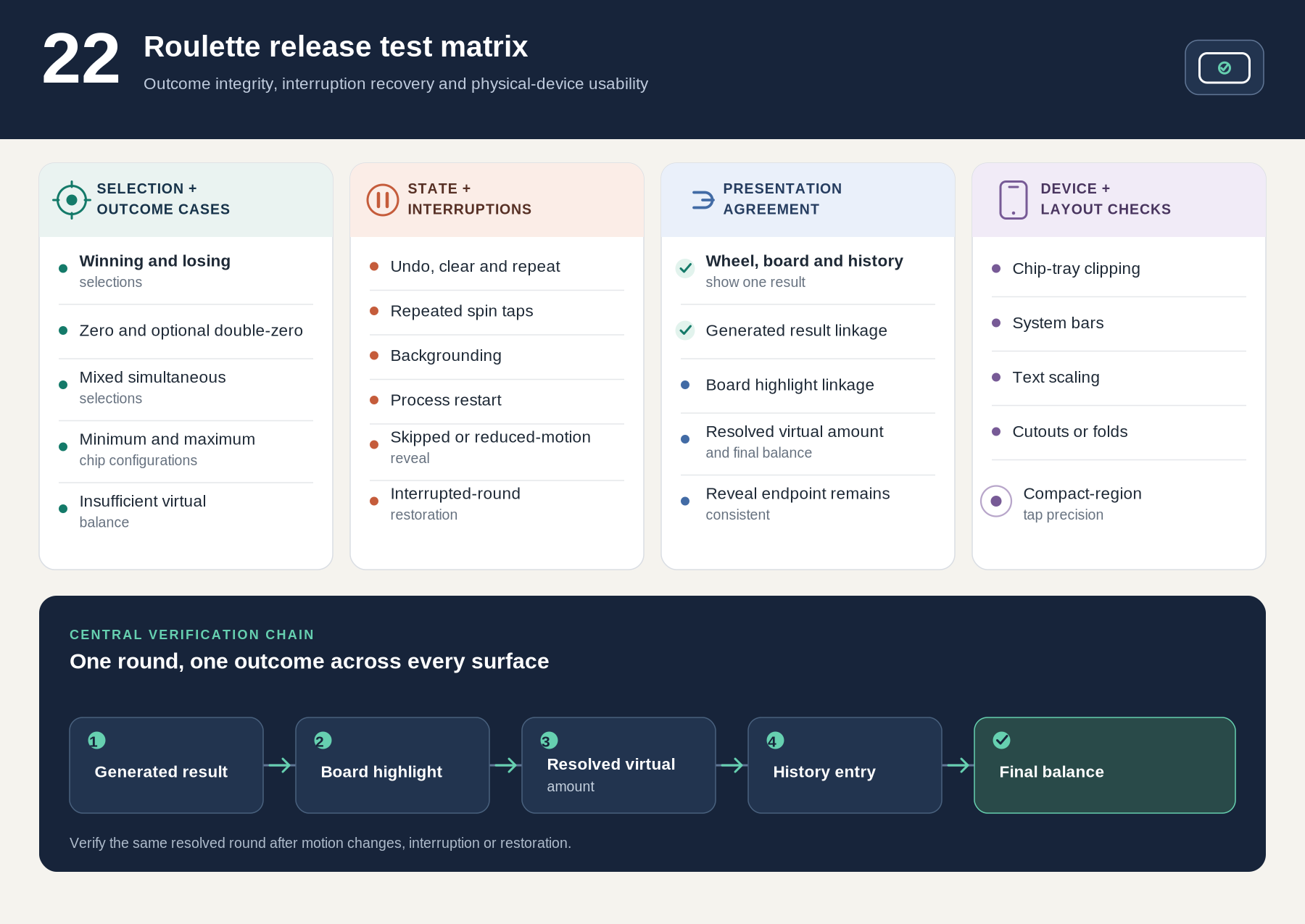
Outcome testing must verify more than the displayed number. For every supported selection type, confirm agreement among the generated result, board highlight, resolved virtual amount, history entry and final balance.
The release checklist should include:
- Winning and losing cases for every enabled selection type
- Zero and, when supported, double-zero handling
- Multiple simultaneous selections with mixed results
- Minimum and maximum permitted chip configurations
- Insufficient virtual-balance behavior
- Undo, clear and repeat actions
- Rapid or repeated taps on the spin control
- Backgrounding during placement, animation and reveal
- Process restart around balance-update boundaries
- Skipped and reduced-motion reveal paths
- Restoration after an interrupted round
- Agreement among wheel result, board highlight and history
Test supported screen sizes and orientations against actual table usability. Check chip-tray clipping, system-bar overlap, text scaling, cutout or fold areas where relevant, and tap precision in compact board regions. Every supported layout should preserve readable results and dependable placement.
Content representation and policy checks
Store assets and text must accurately represent the app as a simulated, play-money table game. Screenshots, descriptions, onboarding and in-app labels should not imply cash prizes, withdrawals or access to real-money betting.
Before publication, the release owner should verify the current Google Play requirements for the product, market and developer account. Review the official Google Play guidance for gambling-related app content and services and app content and target-audience declarations, together with any other requirements displayed in Play Console during submission. Because policies can change, repeat this review for each release.
The final review should confirm:
- The store listing matches the implemented play-money experience.
- Age and target-audience selections are appropriate.
- Privacy disclosures match telemetry and third-party SDK behavior.
- Applicable data collection, consent and deletion handling are documented.
- Virtual chips and balances are described consistently.
- Ads, events and social features match the product representation.
- Distribution territories and declarations have been reviewed.
A strong Android roulette release begins with an explicit ruleset and ends with verified interaction, state handling and content representation. To convert this blueprint into an estimable backlog, scope a roulette-style game with a table game development team around the selected variant, board behavior, app services and release criteria.