
Choosing a social casino game development agency requires more than reviewing artwork and playable demos. A qualified partner must be able to turn the concept into a stable Android release, design a sustainable virtual economy, instrument the product for growth decisions and operate within clear commercial boundaries.
A reliable selection process asks every shortlisted agency to respond to the same scope, support claims with relevant evidence and identify assumptions before contracting. Evaluate four areas:
- Scope fit: What will the agency own, and what remains with your team?
- Technical fit: Can it handle the game systems, Android release, quality assurance and live operations?
- Commercial fit: Are intellectual property, approvals, access and change control unambiguous?
- Evidence: Can the agency demonstrate its capabilities through technical artifacts, demos and focused discovery?
Use the criteria below to build an agency request for proposal (RFP) and compare vendors consistently.
Define your outsourcing scope
Before approaching agencies, document the outcome you are buying. A vague request for “a social casino game” invites proposals based on different assumptions, making price, team and capability comparisons unreliable.
Your initial brief should establish:
- Target devices, Android versions and screen orientations
- Core game concept and intended player experience
- Single-player, tournament, social or synchronous multiplayer requirements
- Virtual currencies, progression systems and monetization assumptions
- Existing code, artwork, designs, backend services or analytics infrastructure
- Required integrations and dependencies
- Geographic or audience constraints affecting product decisions
- Internal stakeholders responsible for product, legal, marketing and release approval
- Responsibilities before and after launch
- Evidence vendors must provide in their responses
Separate confirmed requirements from ideas that still need validation. Ask each agency to list its assumptions, exclusions and client dependencies explicitly rather than hiding them inside a narrative proposal.
Build-only versus build-and-promote
A build-only engagement generally ends with a tested product, release candidate or agreed handover. Your internal team or another supplier then owns acquisition, store presence, campaign execution, analytics interpretation and ongoing growth work.
A build-and-promote engagement extends the agency’s role into launch preparation, creative testing, store listing support, product analytics and retention experiments. This can reduce handoffs, but only when the agency has genuine growth capability rather than treating promotion as an undefined add-on.
Use these questions to identify the right model:
- Who owns product strategy and prioritizes the backlog?
- Who defines acquisition audiences and campaign objectives?
- Who produces and approves promotional creative?
- Who configures events, dashboards and attribution integrations?
- Who analyzes onboarding, engagement, retention and monetization?
- Who decides whether an experiment is shipped, revised or stopped?
- Who responds when campaign data exposes a product issue?
- Which responsibilities continue after the initial Android release?
If growth support is included, require concrete working practices. A vendor should explain how product, engineering, game design, analytics and marketing decisions connect. Avoid accepting “full-service promotion” without named responsibilities, approval rules and reporting expectations.
Code, art, analytics and Play Console access
Ownership and operational access should be defined at the start, not during release. Create a responsibility map covering the code repository, art source files, analytics accounts and Google Play Console.
For each asset or system, record:
- Owner: The organization that legally owns the asset or account
- Administrator: The party allowed to grant or revoke access
- Contributor: The people permitted to make changes
- Approver: The person who authorizes production use or release
- Handover requirement: The files, credentials, documentation and history required at transition
Where practical, business-critical accounts should remain under the buyer’s organizational control, with the agency receiving role-based access. Avoid sharing personal credentials. Google Play Console permissions should reflect actual responsibilities rather than granting broad access by default.
Ask how the agency handles source control, build configuration, signing processes, environment secrets, analytics event definitions and art source files. Confirm that handover includes editable source assets and maintainable project files—not only compiled builds or flattened exports.
Evaluate technical fit
Technical evaluation should test whether the agency can solve the difficult parts of your product. A polished portfolio does not establish who built the underlying systems, what constraints were handled or whether the proposed team has the same expertise.
Request evidence that can be inspected without exposing another client’s confidential information. This may include architecture explanations, anonymized test artifacts, sample reports, demonstrations and interviews with proposed technical leads.
Multiplayer, economy and performance expertise
Social casino products often combine game feel, probability-driven outcomes, progression, virtual currency and social competition. Each system affects the others, so assess game-design depth alongside engineering capability.
For multiplayer or social features, ask the agency to explain:
- Which interactions require real-time synchronization
- How sessions recover from disconnects or interrupted app states
- How server authority and client behavior are separated
- How duplicate actions, retries and inconsistent states are handled
- How matchmaking, leaderboards or tournaments would be tested
- How abusive behavior and suspicious activity are surfaced
- How backend changes are deployed without destabilizing active clients
Economy expertise should include more than configuring rewards. Ask candidates to explain how they would model currency sources and sinks, progression pacing, bonus frequency, purchase flows and segmentation. They should also describe how economy changes are reviewed, measured and rolled back when necessary.
Performance evaluation should reflect representative Android hardware and real gameplay conditions. Request a proposed device test matrix and evidence of how the team investigates:
- Startup and loading behavior
- Frame-rate instability
- Memory pressure and application crashes
- Battery, network and data usage
- Large asset downloads or patching
- Backgrounding, interruptions and session recovery
- Differences between low- and high-spec devices
Do not accept “optimized for Android” as sufficient evidence. Ask what is measured, on which device categories and at what development stages.
QA, security and post-launch support
A credible quality-assurance plan distinguishes automated checks from manual testing and identifies who decides whether a build is ready for release. It should cover gameplay, economy transactions, purchases where applicable, account state, analytics, device compatibility and interrupted network conditions.
Ask each agency for:
- An example test plan or anonymized test-case structure
- Defect severity definitions and triage responsibilities
- Regression testing practices
- Supported device and operating-system criteria
- Release-candidate approval rules
- Crash and application-not-responding monitoring processes
- Procedures for validating analytics events
- A method for recording known issues and accepted risks
Security review should focus on the product’s actual threat model. Ask how secrets are stored, administrative tools are protected, dependencies are reviewed and unauthorized manipulation of balances or player state is prevented. The agency should distinguish controls enforced by the client from those enforced by backend services.
Post-launch support must be operationally precise. Define incident channels, severity levels, escalation contacts, maintenance responsibilities and release authority. No agency can guarantee uninterrupted operation or platform approval, so favor vendors that communicate risks clearly and maintain a documented response process.
For Google Play release readiness, ask how the team tracks current technical and policy requirements, prepares declarations and supports review questions. The publisher remains responsible for verifying that the final product and listing comply with applicable Google Play requirements. Prior release experience is valuable but does not guarantee future approval.
Review commercial terms
A strong technical proposal can still become a poor engagement if the contract leaves ownership, acceptance or decision rights unclear. Procurement and product leadership should review the statement of work together so commercial language reflects how the team will operate.
IP ownership, milestones and change control
The agreement should identify ownership of newly created code, artwork, audio, designs, documentation and data configurations. It should also disclose pre-existing agency materials, third-party software, open-source components and licensed assets that remain subject to separate terms.
Clarify:
- When ownership transfers
- Whether payment status affects transfer
- Which materials are licensed rather than assigned
- Whether the buyer may modify or continue the product with another supplier
- What attribution or license obligations apply
- Whether subcontractors have signed appropriate assignment agreements
- What must be returned or deleted when the engagement ends
Milestones should be tied to inspectable outputs and acceptance criteria. Define who reviews each submission, what constitutes rejection and how defects are distinguished from new requests. Avoid milestones described only as percentages of completion because they provide little basis for objective acceptance.
Change control should require a written description of the requested change, its consequences, dependencies and approval status before work begins. The contract should also explain how urgent production fixes are authorized. This protects both parties from informal requests that later become scope disputes.
Access permissions and reporting rights
Access is a governance issue, not an administrative detail. The buyer should retain enough visibility to assess progress, protect continuity and audit decisions without interfering with daily delivery.
Specify appropriate access to:
- Source-code repositories and version history
- Issue tracking and backlog status
- Build and deployment records
- Design and art working files
- Test results and defect reports
- Analytics schemas and dashboards
- Cloud or backend monitoring
- Google Play Console data and release status
- Third-party service inventories
Reporting rights should identify what is reported, in what format and to whom. Useful reporting separates completed work, upcoming decisions, dependencies, risks, scope changes and release health. If growth support is included, reports should distinguish product metrics from marketing metrics and explain material tracking limitations.
Require an offboarding process covering access revocation, repository transfer, documentation, outstanding defects and administrative ownership. Vendor continuity should not depend on one employee or an agency-controlled account.
Run a fair vendor comparison
Give shortlisted agencies the same core brief, response format, deadline and clarification process. Allow vendors to challenge assumptions, but score them against common criteria. This prevents a persuasive presentation from outweighing relevant evidence.
A practical evaluation sequence is:
- Issue the RFP with scope, constraints and required evidence.
- Collect written responses in a standardized format.
- Hold structured clarification sessions using the same core questions.
- Review demonstrations and interview the proposed delivery leads.
- Run paid discovery if major assumptions remain unresolved.
- Score independently before the evaluation team discusses results.
- Complete commercial, reference and security checks before selection.
- Record the decision reasons and remaining risks.
Demo and paid discovery criteria
A demo should expose capability, not merely provide entertainment. Ask vendors to demonstrate a relevant workflow or system and explain the engineering and design decisions behind it. Confirm which parts the agency created, which team members contributed and whether those people are proposed for your engagement.
Score demonstrations on:
- Relevance to your intended game and Android audience
- Clarity of architecture and design reasoning
- Handling of failure states and edge cases
- Evidence of performance and device testing
- Economy and progression rationale
- Analytics instrumentation
- Build and release discipline
- Ability to answer detailed questions without overstating certainty
Paid discovery is appropriate when critical assumptions cannot be resolved responsibly through a sales proposal. It may examine technical feasibility, architecture, game loops, economy risks, integration constraints and release dependencies. Define discovery questions and expected artifacts in advance. The output should support a go, revise or stop decision—not simply generate a larger sales document.
Red flags and decision scorecard
Investigate further if an agency:
- Guarantees Google Play approval or commercial performance
- Cannot identify the people who will perform the work
- Shows demos but cannot explain its contribution
- Avoids questions about account ownership or source access
- Proposes shared credentials instead of role-based permissions
- Treats analytics as an activity to add after launch
- Cannot explain testing on representative Android devices
- Uses vague milestone or acceptance language
- Will not disclose major third-party dependencies
- Provides no structured change-control process
- Claims growth expertise without explaining measurement or experimentation
- Makes critical capabilities dependent on one individual
- Resists practical handover or offboarding provisions
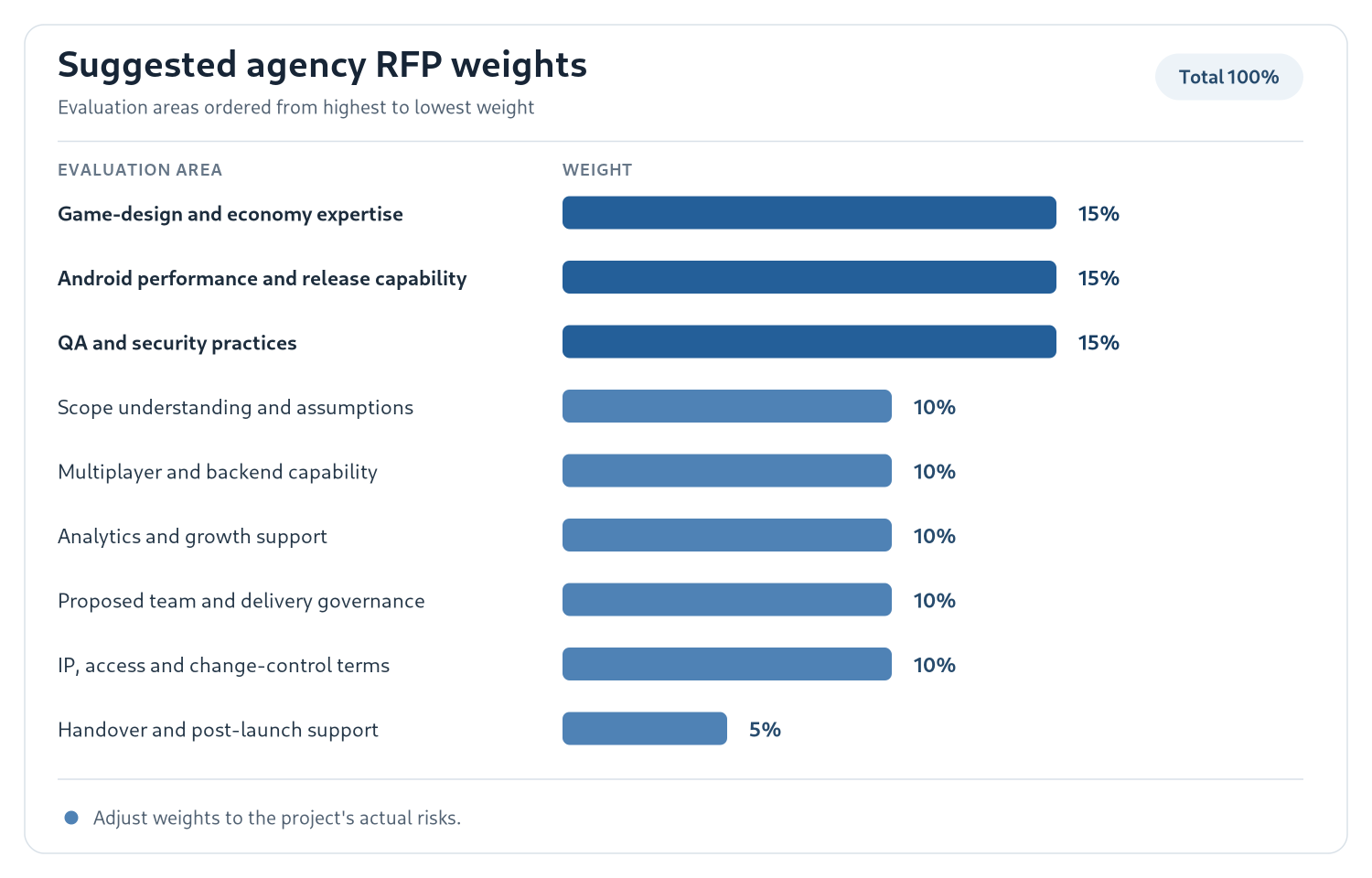
Use this agency RFP scorecard to compare finalists. Assign each criterion a weight totaling 100, score every agency from 1 to 5 and multiply the score by the weight. Define what scores 1, 3 and 5 mean before reviewing proposals.
| Evaluation area | Suggested weight | Evidence to request |
|---|---|---|
| Scope understanding and assumptions | 10 | Written scope interpretation, exclusions and responsibility map |
| Game-design and economy expertise | 15 | Economy approach, progression rationale and design review method |
| Multiplayer and backend capability | 10 | Architecture walkthrough, failure-state handling and relevant demo |
| Android performance and release capability | 15 | Device matrix, profiling approach and release-readiness process |
| QA and security practices | 15 | Test artifacts, defect workflow, threat considerations and dependency process |
| Analytics and growth support | 10 | Event-planning method, reporting example and experiment governance |
| Proposed team and delivery governance | 10 | Named roles, availability, escalation path and decision structure |
| IP, access and change-control terms | 10 | Contract positions, account model and change procedure |
| Handover and post-launch support | 5 | Support process, documentation plan and offboarding checklist |
| Total | 100 |
Weights should reflect the project’s actual risks. Record confidence separately from score: a high score supported only by assertions should not be treated like one backed by inspectable evidence.
A disciplined selection process does not eliminate delivery risk, but it makes ownership, assumptions and trade-offs visible before commitment. To review your scope and evaluation criteria with a prospective delivery partner, arrange a discovery call with our social casino game development team.