
A social casino game MVP should prove one central proposition: a defined audience will repeatedly enjoy a short, play-money casino-style game loop. The first Android release therefore needs polished core gameplay, clear onboarding, a controlled virtual economy, essential analytics, operational support and reliable crash reporting.
It does not need every social system, event format, customization option or content variant envisioned for the full product. Those features should earn their place through evidence of engagement.
This guide helps founders and product owners decide what belongs in an Android social casino MVP, what can wait and which validation milestone should govern each scope decision. It covers entertainment-only gameplay using virtual currency, with no cash prizes, withdrawals or links to real-money betting.
Pick an MVP hypothesis
An MVP is not simply a smaller feature list. It is the smallest coherent product capable of testing a commercially relevant hypothesis.
A useful hypothesis connects five elements:
- Audience: Who is expected to play?
- Motivation: What entertainment need does the game address?
- Core loop: What does the player repeatedly do?
- Expected behavior: What observable action would indicate engagement?
- Risk: Which uncertain assumption could invalidate the concept?
For example, a team might hypothesize that players seeking short, low-friction entertainment will return to a focused virtual slots experience when sessions provide clear progress and a balanced supply of play-money currency.
That statement is more actionable than “build a social casino app.” It narrows design decisions and identifies what the MVP must measure.
Genre, audience and core session loop
Choose one primary game format for the MVP. A focused implementation provides cleaner evidence than a lobby containing several underdeveloped games.
The choice may be a virtual slots game, table-inspired game or another casino-style format designed purely for play-money entertainment. Define its rules and session structure before adding peripheral systems.
A core session loop could be:
- The player opens the app and views a virtual currency balance.
- The player chooses a permitted play level.
- The player completes a short round using clear controls.
- The game calculates the virtual result correctly.
- The player sees progress, feedback or a short-term objective.
- The player starts another round or leaves with a reason to return.
Each element should support the hypothesis. If a proposed feature does not improve comprehension, enjoyment, repeat play, measurement or stability, it is a candidate for deferral.
Audience definition should be equally specific. Record assumptions such as:
- familiarity with the chosen game format;
- preference for brief or extended sessions;
- tolerance for tutorials and layered interfaces;
- accessibility needs, including readable controls and adjustable audio;
- device and Android version coverage;
- regional, age-rating and content expectations.
Avoid treating “casino players” as one uniform audience. A user looking for a quick, familiar loop may behave differently from someone motivated by collecting, competition or long-term progression.
Success metrics and risks
Select metrics that can confirm or challenge the MVP hypothesis. Do not build a broad dashboard before deciding which questions the data must answer.
| Question | Example signal | Product decision it supports |
|---|---|---|
| Do new players understand the game? | Tutorial and first-round completion | Simplify onboarding or clarify controls |
| Does the core loop hold attention? | Rounds per session and session patterns | Refine pacing, feedback or rules |
| Do players return? | Cohort-based return behavior | Continue, revise or reconsider the loop |
| Is the virtual economy usable? | Balance changes, reward claims and blocked sessions | Adjust play-money sources and sinks |
| Is the build stable? | Crash-free usage and failures by device | Fix stability before expanding reach |
| Where does friction occur? | Funnel exits and error events | Prioritize usability or technical corrections |
| Is support manageable? | Issue categories and repeated complaints | Improve product clarity or support tools |
Set release criteria as ranges or thresholds agreed before results arrive. Suitable targets depend on the genre, audience, traffic quality and product goals.
Document major risks alongside the metrics:
- players do not understand the rules quickly;
- the main interaction becomes repetitive too soon;
- feedback and progression provide little reason to continue;
- the virtual economy blocks play or removes meaningful pacing;
- instrumentation produces incomplete or misleading data;
- device-specific problems obscure product signals;
- store listing, content rating, privacy or distribution requirements delay publication.
Measurement should make the next scope decision defensible, not make an early build appear successful.
Prioritize core features
The MVP must feel complete within its narrow promise. “Minimum” should reduce breadth, not excuse broken rules, unclear controls or unreliable data.
The following prioritization grid separates launch requirements from features that should wait for evidence.
| Product area | Must have for the MVP | Add later if evidence supports it |
|---|---|---|
| Core gameplay | One polished format, correct rules, responsive controls and clear outcomes | Additional game types, variants and larger content libraries |
| Onboarding | Short introduction, contextual guidance and an obvious first action | Personalized tutorials and advanced coaching |
| Virtual economy | Play-money balance, defined sources and sinks, reward logic and safeguards | Multiple currencies, complex collections and layered rewards |
| Progression | One understandable short-term progress mechanism | Multiple tracks, seasons and prestige systems |
| Interface | Essential navigation, settings, readable balances and status feedback | Themes, avatars and deep interface personalization |
| Analytics | Core funnel, session, round, economy and error events | Predictive segmentation and complex experimentation |
| Reliability | Crash reporting, error handling and device-level diagnostics | Advanced live-operations automation |
| Support | Accessible help, rules, contact route and issue context | Community moderation and large support portals |
| Social features | A minimal sharing or identity element only if central to the hypothesis | Clubs, gifting, team competition and social feeds |
| Content operations | Safe configuration of essential game values | Full event tooling and large content workflows |
A “later” classification does not mean a feature lacks value. It means the MVP does not yet have enough evidence to justify its product and operational complexity.
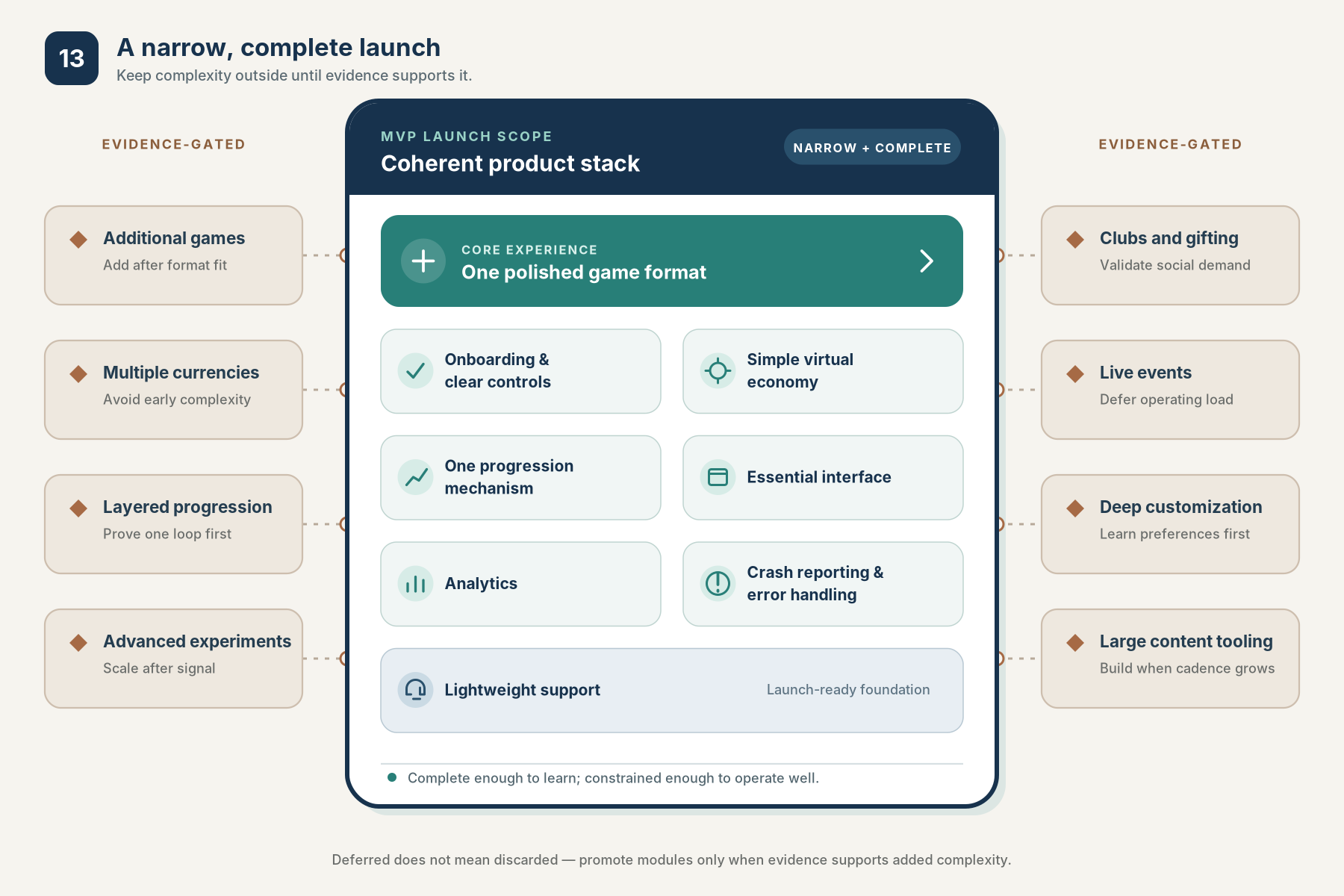
Game rules, onboarding and virtual economy
Game logic is foundational. Outcomes, virtual balance changes, displayed values and progress updates must remain internally consistent. Interrupted sessions, connection loss and repeated input need defined behavior rather than visual workarounds.
Onboarding should bring the player to a meaningful first action quickly while explaining essential rules. Favor contextual instruction over a long sequence of screens. The first session should answer:
- What can the player do?
- What does each control mean?
- How is virtual currency used?
- How is progress shown?
- What happens when the balance is insufficient for the selected action?
- Where can rules, settings and support be found?
The virtual economy should be simple enough to model and inspect. Define every source of play-money currency, every sink and the intended relationship between them. Include the opening balance, permitted play levels, routine rewards and any recovery paths appropriate to the concept.
Economy testing should cover more than average balances. Check whether interrupted requests, duplicate actions or unusual behavior can create inconsistent states. The interface must never suggest that virtual currency is withdrawable, redeemable for cash or connected to real-money betting.
Keep progression restrained. A single level path, collection goal or unlock sequence may be sufficient to test whether players value a longer-term objective. Several overlapping tracks make it difficult to identify which mechanic affected behavior.
Analytics, support and crash reporting
Analytics is part of the MVP, not a post-release add-on. Without reliable instrumentation, a beta may generate activity without producing usable evidence.
Create a concise event model covering:
- onboarding steps;
- first and subsequent rounds;
- selected play level;
- virtual currency sources and sinks;
- reward presentation and collection;
- progression changes;
- navigation to rules, settings and support;
- recoverable and blocking errors;
- session start, interruption and completion.
Each event should have a defined purpose, trigger and permitted properties. Test events against gameplay so retries, reconnections or duplicate client actions do not distort the dataset.
Crash reporting should capture enough device and application context to reproduce failures without collecting unnecessary personal information. Product and engineering teams also need a triage convention that separates crashes, rule defects, visual issues, economy inconsistencies and analytics defects.
Support can remain lightweight, but players need an accessible route to rules, help and contact information. Reports should include relevant application context where appropriate so the team can distinguish isolated misunderstandings from systemic defects.
Privacy choices must align with the data collected by the app and its integrated services. Before publication, verify current Google Play requirements for the store listing, age or content declarations, privacy disclosures and distribution eligibility. Consult Google’s current official guidance, including its real-money gambling, games and contests policy and store listing and promotion policy.
Defer nonessential scope
Scope discipline matters most when an attractive feature does not directly test the MVP hypothesis. Every additional system introduces design, implementation, testing, analytics and support obligations.
Ask three questions when reviewing optional scope:
- Is this feature necessary for the core loop to function?
- Will its absence prevent the team from evaluating the hypothesis?
- Is the team ready to operate and support it after release?
If the answer to all three is no, move the feature to the evidence-gated backlog.
Social clubs, live events and deep customization
Social clubs can support long-term engagement, but they introduce membership rules, invitations, permissions, abuse handling, moderation and notifications. Unless group interaction is central to the hypothesis, clubs should follow evidence that players already value the underlying game.
Live events create similar overhead. A credible event system may require scheduling, configuration, eligibility logic, progress tracking, reward handling, time-zone behavior and customer support. First confirm that the core loop retains enough players to make scheduled content meaningful.
Deep customization—including avatars, profile decoration, themes or collectible sets—should also wait unless self-expression is fundamental to the concept. One coherent visual identity is generally more useful for an MVP than a large inventory of cosmetic choices.
Promote these features only when evidence points to a specific need, such as:
- engaged players need longer-term goals;
- repeat users seek more content variety;
- an audience segment demonstrates social motivation;
- progression reaches its limit too quickly;
- tested personalization improves relevant behavior.
Backend complexity and ongoing support
Backend scope should match immediate operational needs. Avoid building a generalized platform for hypothetical future features.
The MVP may need services for player state, virtual balances, configuration or account continuity, depending on its architecture. It does not automatically need a complex event platform, club service, multi-game content system or elaborate administrative suite.
Evaluate each backend component by its continuing burden:
- How will it be monitored?
- What happens when it fails?
- Does it create manual support work?
- Does it store data requiring additional privacy handling?
- Can values be changed safely?
- Must compatibility be maintained across app versions?
- Who resolves inconsistent player state?
Operational simplicity protects validation quality. If the team spends the beta resolving avoidable system interactions, it may never learn whether the core game is engaging.
Plan the validation milestones
Validation milestones should function as decision gates, not ceremonial dates. Each gate must state what is being tested, what evidence is required and which scope decisions follow.
Prototype, beta and release criteria
Use three evidence-oriented gates:
| Gate | Primary question | Evidence to review | Typical decision |
|---|---|---|---|
| Prototype | Is the core interaction understandable and enjoyable enough to continue? | Observed comprehension, usability, pacing and rule clarity | Refine the loop, continue or stop |
| Beta | Does the narrow product work reliably and generate trustworthy data? | Funnel behavior, repeat sessions, economy flow, defects and device performance | Fix, retest or prepare for release |
| Release | Is the product stable, supportable and ready for Android distribution? | Acceptance checks, analytics validation, support readiness and policy review | Release, limit distribution or hold |
Before moving from beta to release, confirm that:
- core rules and virtual balance changes are correct;
- first-time players can complete the main interaction;
- analytics events have been validated;
- critical crashes and blocking defects are resolved;
- support and rules are accessible;
- privacy disclosures reflect actual data practices;
- store assets accurately represent play-money gameplay;
- current Google Play listing, age, privacy and distribution requirements have been reviewed.
Backlog for post-launch development
A useful backlog links each deferred feature to evidence rather than enthusiasm. Record the problem, signal, expected outcome and operational consequence.
For example, do not list “add clubs” alone. Reconsider clubs if retained players demonstrate demand for group goals and the team can support membership and moderation workflows.
Review post-launch candidates in this order:
- Correctness and stability: Resolve defects that undermine trust or measurement.
- Core-loop improvements: Address data-supported friction, pacing or clarity issues.
- Content depth: Expand proven interactions before introducing unrelated systems.
- Progression and economy: Add depth when existing goals or balance patterns justify it.
- Social and live features: Introduce them when behavior and operational capacity support them.
- Customization: Expand identity and cosmetic options in response to demonstrated demand.
A well-scoped social casino game MVP is not the smallest app a team can ship. It is the narrowest reliable product that can produce credible evidence about engagement. Protecting that purpose helps founders avoid premature complexity and direct later development toward features players have shown they value.
If you are deciding what belongs in your first Android release, review our social casino game development service and request an MVP scoping workshop to turn the product hypothesis into a focused, testable feature set.