
Effective social casino game ad creative production turns authentic gameplay into clear, adaptable assets without misrepresenting the player experience. A repeatable pipeline should cover format selection, scripts, storyboards, gameplay capture, motion design, localization, compliance review and final exports.
For Creative Leads and publishers, the main challenge is scaling production without losing control. Poker, blackjack and slots each require a different visual rhythm, but every asset must remain faithful to the game, consistent with the brand and suitable for its intended platform and market.
Before production begins, confirm advertising eligibility. Paid promotion is subject to platform- and country-specific rules. Google Ads social casino advertising requires certification for eligible advertisers and markets. Campaigns may also face geographic, age, account, creative and destination restrictions. Check the current Google Ads social casino games policy before approving concepts or booking production capacity.
Choose creative formats
Select formats according to what each asset needs to communicate, not simply what is easiest to resize. Gameplay video is often the production foundation because it can supply footage for motion ads, short edits and supporting static frames. Playable concepts can demonstrate a focused interaction, while static assets communicate one proposition quickly.
Build the format plan around three questions:
- What should viewers understand? This may be the pace of a poker table, the decision flow in blackjack or the visual spectacle of a slot feature.
- What material exists in the current build? Confirm that required interfaces, animations and game states are available and stable enough to capture.
- Where will the asset run? Record the placement, orientation, duration, file and policy requirements before design begins.
A format matrix prevents teams from treating one master file as a universal deliverable.
| Format | Best production role | Essential inputs | Main production risk |
|---|---|---|---|
| Gameplay video | Demonstrating the real game loop and visual tempo | Stable build, capture plan, script and clean recordings | Editing that implies unavailable interactions or outcomes |
| Motion graphic ad | Combining gameplay with branding, captions and transitions | Gameplay selects, design system and motion specifications | Overloading a short sequence with messages |
| Playable concept | Presenting one understandable interaction | Approved interaction model, UI references and clear end state | Departing from the actual product experience |
| Static asset | Delivering one concise visual proposition | High-resolution artwork, interface elements and copy | Trying to explain a complete game loop in one frame |
| Cutdown or adaptation | Extending an approved master across placements | Editable source files and export matrix | Losing readability after changing aspect ratio or duration |
Gameplay video, playable concepts and static assets
For poker, footage should make the table state and player action readable. Cards, controls, turn order and reactions need enough screen time to be understood. Fast editing can create energy, but it should not make decisions appear automatic or conceal how play works.
For blackjack, the key interaction often depends on a short sequence: the initial hand, the available decision and the resulting game response. Capture enough context for that action to remain intelligible after trimming.
For slots, motion assets can emphasize reels, symbols, animation and feature transitions. Preserve the relationship between the player’s action and the in-game response instead of assembling unrelated highlights into an artificial sequence.
Playable concepts require a narrow brief. Define the interaction, expected input, visual feedback and transition to the destination. The concept should resemble the promoted game closely enough that users are not led to expect a different interface or mechanic.
Static assets work best with one focal point:
- a recognizable table or reel view;
- a clear character or themed environment;
- one short message;
- a legible logo;
- a restrained call to action.
Static production is a distinct composition task, not a screenshot combined with an entire video script.
Audience-specific message hierarchy
Audience adaptation should change emphasis without changing the truth of the product. Establish this hierarchy for every concept:
- Opening cue: The first visual or line identifying the experience.
- Primary message: The single idea the viewer should retain.
- Proof: Authentic gameplay or an interface state supporting the message.
- Brand identification: The game name and recognizable visual system.
- Next action: A direct, placement-appropriate call to action.
The hierarchy may emphasize social table atmosphere, decision-making, visual themes or pace of play. It should not imply unsupported functionality, outcomes or availability.
Separate mandatory information from optional copy so designers can protect critical messages when adapting assets to smaller canvases or shorter durations. Document safe areas, maximum line counts and minimum readable text sizes in the design specification.
Capture honest gameplay
Honest gameplay capture begins with a controlled build and written shot list. Record what the player can see and do, including enough context to understand every featured interaction.
Before the capture session, prepare:
- the approved app build and device configuration;
- test accounts or approved game states;
- a shot list connected to the storyboard;
- required orientations and capture resolution;
- notifications and unrelated overlays disabled;
- approved audio settings;
- a log for the build version, scene, take and notes.
Capture longer handles before and after each intended action. Editors need this material to adjust timing without manufacturing a sequence from incompatible moments. Record clean interface footage separately from decorative overlays so captions and branding can be adapted later.
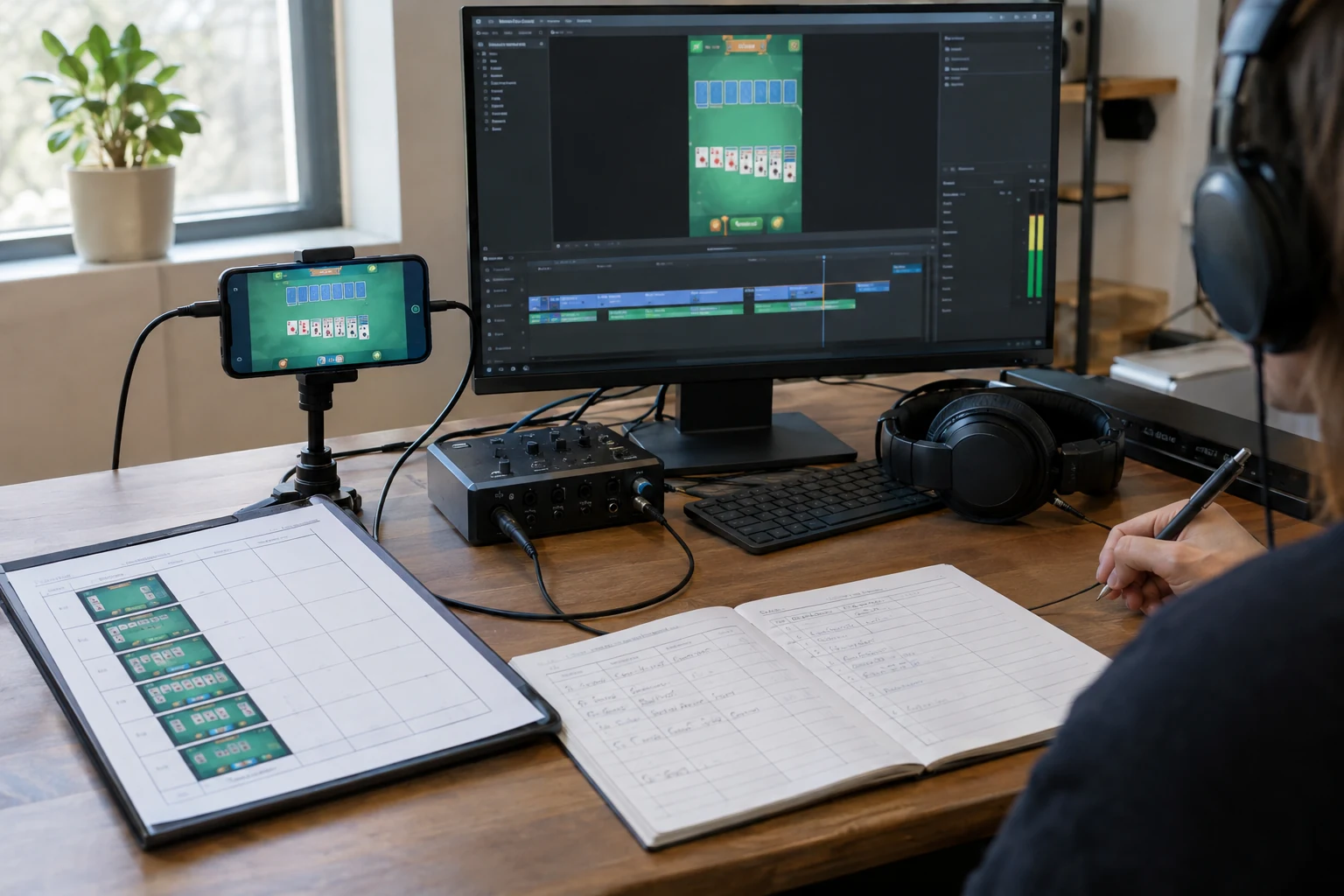
Feature demonstration and interface fidelity
Interface fidelity means preserving the recognizable appearance, sequence and behavior of the promoted game. A video does not need to show an uninterrupted session, but edits should maintain a plausible relationship between actions and responses.
Use these checks during capture and editing:
- Controls appear where players will find them in the promoted version.
- Cards, reels, tables, menus and feedback states use current designs.
- Player actions lead to the responses shown.
- Captions do not cover information needed to understand play.
- Enlarged interface elements remain identifiable as visual emphasis.
- Decorative transitions are not mistaken for in-game functionality.
- Footage from different builds does not create inconsistent screens.
- The destination matches the game and experience presented.
If a concept uses dramatized framing, distinguish it visually from gameplay and assess whether viewers could confuse it with a real feature. When fidelity cannot be maintained, revise the concept rather than forcing available footage into an unsuitable script.
Brand consistency and copyright checks
A production-ready brand pack should define logo use, colors, typography, iconography, character treatment, tone and audio direction. Supply editable files and rules for backgrounds, clear space and minimum sizes.
Confirm authorization for:
- artwork, characters and environment assets;
- fonts and typeface weights;
- music, sound effects and voice recordings;
- stock footage or templates;
- card, table and symbol designs;
- creator, partner or third-party branding;
- localized copy and recorded performances.
Maintain a source record for each asset, including its owner, approved use and relevant territory, duration or placement limitations. Replace or escalate any element whose status cannot be verified before assembly.
Design production workflow
A repeatable workflow reduces rework by moving important decisions upstream:
- Create the production brief. Record the game, audience, proposition, formats, placements, markets, deadlines and approval owners.
- Confirm eligibility and restrictions. Check advertiser, market, age, account, destination and creative requirements.
- Write the script and shot list. Connect every claim or caption to a visual that can be captured or produced.
- Build the storyboard. Specify scenes, timings, gameplay states, overlays, transitions, audio and end frames.
- Approve design specifications. Lock aspect ratios, safe areas, typography, logo rules and export requirements.
- Capture gameplay. Use the approved build, shot list and capture log.
- Produce master assets. Assemble motion, static or playable material using editable source files.
- Create planned variants. Change only approved modular elements.
- Localize. Translate, adapt layouts and review the result in context.
- Run review gates. Complete product, brand, rights, compliance and technical checks.
- Export and package. Apply a documented naming convention and validate every file.
- Archive the release. Store approved masters, source files, review status and usage details.
Storyboards, variants and localization
A storyboard is a production document, not merely a collection of attractive frames. Each panel should identify its source material and state whether it represents gameplay, motion graphics, a transition or an end card. Include timing, on-screen copy, audio cues and elements that must remain editable.
Design variants as modules. Keep the opening hook, gameplay body, text layer and end frame separable. Modular construction supports efficient adaptation while reducing accidental changes to approved material.
Localization should account for:
- text expansion or contraction;
- line breaks and reading order;
- font support for required characters;
- local terminology and cultural context;
- voice-over timing and subtitle synchronization;
- date, number and interface conventions;
- market-specific policy or destination requirements.
Review each localized creative as a rendered asset. A translation can be correct in a spreadsheet but unreadable in the final composition. Record approval by locale rather than treating one master approval as universal.
Review gates for restricted ads
Restricted-category review should occur at defined gates instead of becoming a final check immediately before launch.
| Review gate | Owner or reviewer | Approval question |
|---|---|---|
| Concept | Creative and publishing stakeholders | Can this idea be shown honestly with available game material? |
| Eligibility | Authorized campaign stakeholder | Is promotion permitted for the advertiser, market, audience and destination? |
| Product fidelity | Product or game representative | Does the asset accurately represent the current game? |
| Brand and rights | Brand and rights owners | Are all visual, audio and third-party elements approved? |
| Policy | Qualified compliance reviewer | Does the finished asset meet current platform and market restrictions? |
| Technical delivery | Production or trafficking team | Does every export match the required specification? |
Approval for one market, account or platform should not be assumed to cover another. Recheck requirements whenever the destination, geography, audience, creative content or distribution account changes.
Measure and refresh assets
Production does not end when files are delivered. Creative teams need a controlled intake for performance and quality signals so they can identify assets requiring replacement, repair or a new production cycle.
Detailed experiment design and results interpretation belong with the team responsible for campaign testing. The production function should focus on actionable asset requests and version control.
Engagement, quality and fatigue signals
Agree on a concise handoff from campaign teams. Useful production signals may include:
- the asset and version that ran;
- placement, market, language and date range;
- whether delivery was sufficient to assess the asset;
- engagement or viewing signals relevant to the format;
- quality issues such as weak opening clarity or unreadable copy;
- policy disapprovals or destination mismatches;
- indications that repeated exposure warrants a refresh.
Translate these signals into production actions: shorten an opening, improve interface visibility, replace outdated footage, correct localization, update an end frame or commission a new concept. Never overwrite the original file; create a traceable revision.
Creative library governance
Use one searchable library as the source of truth. Each asset record should include the game, format, orientation, duration, language, market, build version, approval state, rights status, creation date and retirement status.
Use this ad creative production checklist before release:
- [ ] Format and placement specifications are documented.
- [ ] The intended market, audience and destination are identified.
- [ ] Current platform eligibility and restrictions have been checked.
- [ ] Scripts and storyboards use demonstrable game features.
- [ ] Gameplay comes from an approved, recorded build.
- [ ] Interface behavior remains faithful after editing.
- [ ] Brand, copyright, music, font and third-party rights are cleared.
- [ ] Variants follow the approved message hierarchy.
- [ ] Localized assets have been reviewed in their final layout.
- [ ] Product, brand, rights, policy and technical approvals are recorded.
- [ ] Exports pass file, orientation, duration and readability checks.
- [ ] Source files and final assets use consistent version names.
- [ ] Refresh or retirement decisions are logged without deleting history.
A governed library makes future production faster by distinguishing reusable components from expired, restricted or outdated material.
For support building this pipeline—from gameplay capture and storyboards through localization and export—explore our mobile game marketing services and request a game creative production estimate.