
A social casino game testing checklist must verify more than whether a slot, card or wheel mechanic runs. For an Android release candidate, QA should prove that game rules remain consistent across interruptions, virtual-credit balances reconcile correctly, purchases recover safely, service integrations emit the expected events, and supported devices preserve a usable experience.
This checklist applies only to virtual/play-money social casino gameplay. It does not cover cash prizes, withdrawals or connections to real-money betting. Before release, verify the product’s current Google Play listing, age suitability, privacy disclosures and distribution approach against applicable Google Play policies.
Use this reusable Android QA matrix as the control sheet for each release candidate:
| Test dimension | Required coverage | Pass condition | Evidence |
|---|---|---|---|
| Game rules | Outcomes, scoring, stake limits and bonus behavior | Displayed results and virtual-credit awards match approved rules | Video, screenshots and account state |
| Rewards | Daily rewards, achievements, bonuses and duplicate claims | Each eligible reward is granted once and recorded correctly | Balance history and server logs |
| Purchases | Success, cancellation, delay, interruption and restoration | Entitlement is granted once after confirmed purchase state | Purchase record, balance history and device logs |
| Compatibility | Supported OS versions, screens, chipsets and memory tiers | No release-blocking functional or presentation defects | Device inventory and test report |
| Lifecycle | Backgrounding, process loss, rotation and network changes | Sessions recover without duplicate outcomes or lost state | Reproduction steps and state snapshots |
| Integrations | Sign-in, analytics, notifications and crash reporting | Services handle success and failure without corrupting gameplay | Event traces and integration logs |
| Release approval | Regression, smoke tests, defect review and staged exposure | Exit criteria are met with documented residual risk | Signed test summary |
Model functional coverage
Derive functional coverage from the product’s state model rather than its screens alone. Build a traceable list of game rules, virtual-credit transactions, reward conditions and recovery paths. Each test should identify its starting state, action, variation, expected result and authoritative record.
| Test-case field | What to record |
|---|---|
| Preconditions | Account status, balance, game configuration and connectivity |
| Action | Player input or system event |
| Variation | Stake, timing, repeated tap, interruption or device condition |
| Expected UI result | Outcome, message, animation and next action |
| Expected account result | Balance change, reward state and transaction status |
| Recovery expectation | State after retry, relaunch or sign-in elsewhere |
| Evidence | Build, device, account, timestamp, logs and recording |
Game rules, rewards and interrupted sessions
Translate every approved rule into positive, negative and boundary tests. Controlled configurations or test accounts make it easier to prove whether a specific rule was applied than long exploratory sessions alone.
The core checklist should include:
- [ ] Minimum and maximum virtual-credit stakes are enforced.
- [ ] Stake controls cannot produce unsupported or negative values.
- [ ] A round cannot start without the required virtual-credit balance.
- [ ] The displayed stake matches the amount deducted.
- [ ] Outcomes, paylines, hands, symbols or scoring match approved rules.
- [ ] Awards are added once and match the displayed result.
- [ ] Bonus entry and exit conditions work at each eligible stake.
- [ ] Feature counters persist across screens and relaunches.
- [ ] Rapid taps cannot start overlapping rounds or duplicate claims.
- [ ] Input is blocked while a result is being committed.
- [ ] Help, rules and reward descriptions match implemented behavior.
Test rewards separately because they may combine client timers, server state and account eligibility. Cover first-time and repeat claims, expired offers, clock changes, delayed responses and attempts from a second device. A reward animation is not proof of delivery; compare the authoritative balance before and after the claim.
For interrupted sessions:
- Start with a known balance and game state.
- Begin a round or reward claim.
- Interrupt before submission, while pending, and after acceptance but before the UI updates.
- Resume, relaunch after process termination and sign in again where applicable.
- Confirm the outcome is safely abandoned or restored—not lost, replayed or awarded twice.
- Compare the UI, local cache and server-side account record.
Include screen locking, app switching, supported rotation, calls and operating-system process reclamation.
Purchase and virtual-credit state
Treat the purchase flow and virtual-credit ledger as related but distinct systems. A pending or cancelled purchase must leave the interface coherent, and returning to the game must not be interpreted as proof of completion.
| Purchase condition | Expected behavior | Balance check |
|---|---|---|
| Completed and confirmed | Grant the purchased virtual item once | One matching credit entry |
| Player cancels | Return to a usable store or game state | No balance change |
| Payment remains pending | Show a non-final state without granting early | No premature credit |
| Connection drops | Reconcile when status can be confirmed | No duplicate or missing grant |
| App closes before confirmation UI | Recover confirmed entitlement after relaunch | Exactly one credit entry |
| Callback or retry repeats | Process idempotently | No second grant |
| Account changes during recovery | Apply entitlement only to the correct account | Account records remain isolated |
Run relevant cases for every purchasable package and account condition. Include repeated taps, store-screen backgrounding, poor connectivity, device restart and supported purchase recovery outside the immediate UI flow.
The virtual-credit checklist should verify:
- [ ] Every balance change has a recognizable source.
- [ ] Displayed totals use consistent rounding and formatting.
- [ ] Spending and awards cannot race into an impossible balance.
- [ ] A failed round does not consume credits without a resolved result.
- [ ] Cached balances reconcile after reconnecting or changing devices.
- [ ] Promotional and purchased credits follow approved product rules.
- [ ] Guest upgrades, account resets and sign-outs do not merge balances incorrectly.
- [ ] Errors do not present unconfirmed purchases as successful.
Use non-production accounts and approved test mechanisms. Retain transaction state and entitlement evidence without exposing sensitive account or payment information.
Test Android device variability
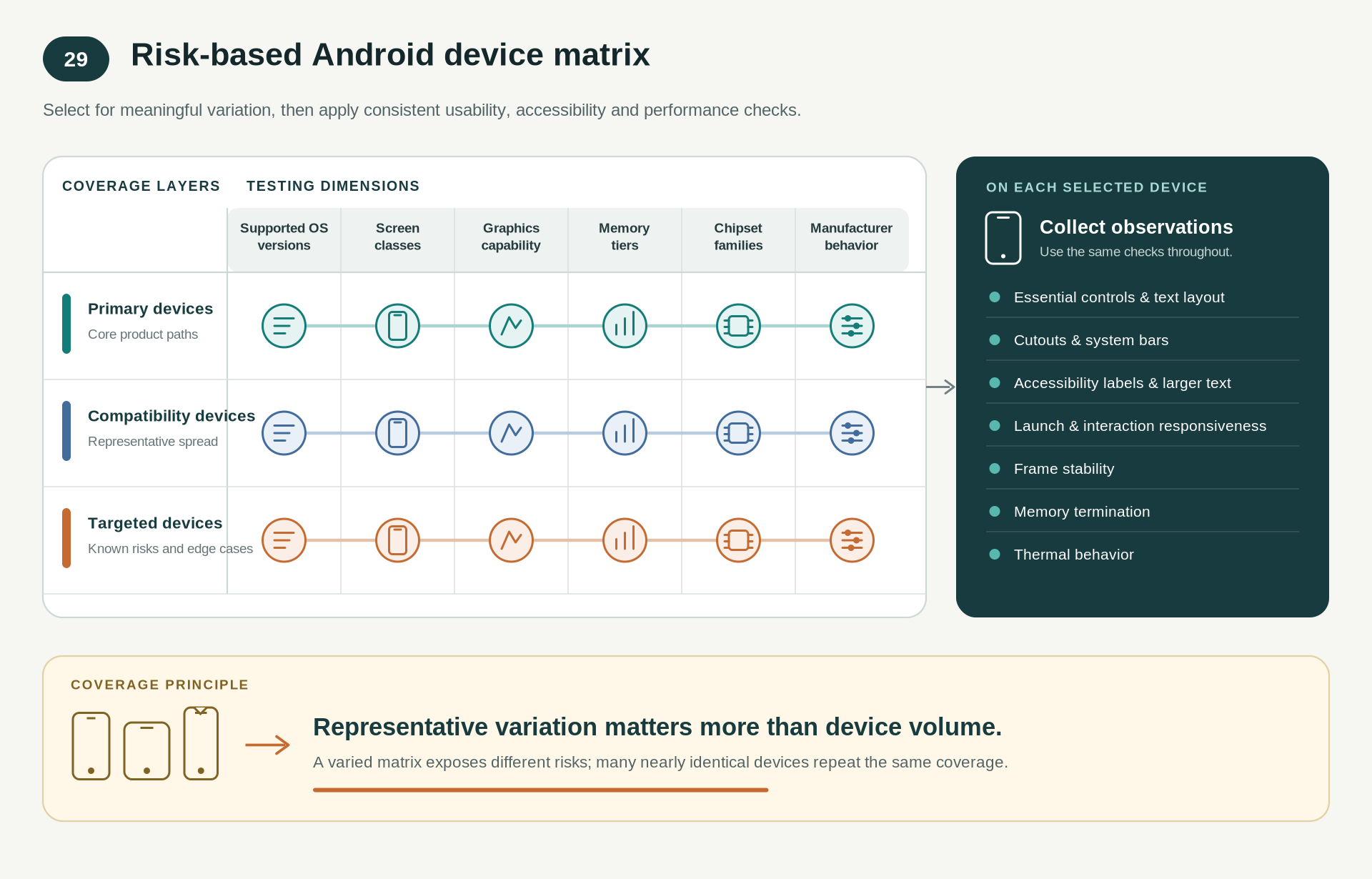
Build a risk-based Android matrix using supported OS versions, screen classes, graphics capability, memory tiers, chipset families and manufacturer behavior. A small matrix with meaningful variation provides more confidence than many nearly identical devices.
Define three layers:
- Primary devices: Used for every release-candidate regression.
- Compatibility devices: Representative older, lower-resource or unusual-screen devices.
- Targeted devices: Selected for known defects, integration risks or crash patterns.
Record the model, OS version, memory condition, screen configuration, build and installation path for every result.
Screen sizes, performance and accessibility
Inspect the game board, store dialogs, rules, consent interfaces, rewards, loading states, errors and system permission flows.
- [ ] Essential controls remain visible and tappable.
- [ ] Text does not clip, overlap balances or obscure purchase information.
- [ ] System bars, cutouts, rounded corners and gestures do not hide controls.
- [ ] Orientation behavior follows the product specification.
- [ ] Dialogs remain usable with larger supported text settings.
- [ ] Color is not the only indicator of selection, result or error.
- [ ] Important controls have meaningful accessibility labels and navigation order.
- [ ] Animations do not block rules, balances or recovery actions.
- [ ] Localized or long test strings fit critical interfaces.
Measure launch completion, time to an interactive game, frame stability, input responsiveness, memory-related termination and thermal behavior on each device tier. Define project acceptance thresholds before testing to avoid subjective release decisions.
Test both fresh installations and mature accounts with accumulated history or cached assets. Resource problems may appear only after long sessions, repeated navigation or multiple game changes.
Offline modes, battery and lifecycle
Define expected offline behavior for each feature. Cached navigation may remain available while a new server-authoritative round is blocked. Without an explicit requirement, testers cannot distinguish graceful degradation from a defect.
Cover:
- Online-to-offline transitions before a round
- Connection loss while a result is pending
- Offline relaunch
- Slow or unstable connectivity
- Wi-Fi-to-mobile-data changes
- Reconnection after a prolonged pause
- Repeated retry input while disconnected
The game should explain unavailable actions, preserve recoverable state and avoid fabricating final outcomes. After reconnection, it should reconcile the authoritative session before allowing conflicting actions.
Test battery use during normal play, animations, audio, downloads and background behavior. Record excessive drain or heating against a repeatable scenario.
Lifecycle coverage should include:
- Background and resume after different durations
- Screen lock and unlock
- Process termination while backgrounded
- Device restart and low-memory conditions
- Supported rotation or configuration changes
- Audio interruption and restoration
- Account expiry or sign-out during suspension
Validate service integrations
Test platform and third-party services independently. A successful call does not prove gameplay remains safe when authentication expires, analytics is unavailable or a notification opens an obsolete destination.
Maintain an inventory of each service, triggering event, expected data, timeout behavior, retry rule and player-facing fallback.
Sign-in, analytics and notification events
Cover guest entry, returning accounts, cancelled authentication, expired sessions, network failure and account switching. Confirm that the correct balance follows the authenticated account and failed sign-in cannot overwrite local progress.
Create an analytics event contract:
| Event area | Validation question |
|---|---|
| Session | Is start or resume recorded once at the defined boundary? |
| Game round | Is the event emitted only when the corresponding state occurs? |
| Reward | Are granted, rejected and already-claimed states distinct? |
| Purchase | Are initiated, pending, cancelled, failed and confirmed states distinct? |
| Error | Is useful context included without sensitive data? |
Test notification receipt, dismissal and opening from foreground, background and terminated states. Deep links should reach valid destinations, handle expired offers safely and fall back appropriately when a target is unavailable. Repeated opens must not duplicate rewards.
Crash handling and safe retries
Reproduce failures at high-risk boundaries: round submission, result display, reward claim, purchase confirmation, sign-in completion and content loading.
After each failure:
- Relaunch the same build and account.
- Determine whether the transaction was accepted before the crash.
- Reconcile the app with the authoritative state.
- Retry only when the operation is known to be safe.
- Check for duplicated virtual credits, rewards or purchases.
- Confirm that evidence identifies the build, device and flow.
Classify retryable operations as read-only, idempotent or unsafe without reconciliation. Limit automatic retries, prevent rapid manual duplication and show a recoverable error when the final state is uncertain.
Approve release candidates
Agree on device coverage, mandatory flows, acceptable residual defects, evidence standards and the decision owner before testing begins.
- [ ] The build identifier and configuration are fixed.
- [ ] Functional, purchase, lifecycle and integration suites are complete.
- [ ] Required primary and compatibility devices have passed.
- [ ] Open defects have assigned severities and documented impact.
- [ ] Purchase and virtual-credit reconciliation tests have passed.
- [ ] Crash and retry paths preserve account state.
- [ ] Policy-sensitive descriptions and flows have been reviewed.
- [ ] Smoke-test evidence is attached to the approval record.
Before publication, review the current Google Play policy guidance and additional applicable Google Play requirements. Verify current listing, age, privacy and distribution requirements instead of relying on a previous release review.
Severity definitions and test evidence
Severity describes impact, not scheduling preference.
| Severity | Definition | Typical release treatment |
|---|---|---|
| Blocker | Testing or essential use cannot continue | Replace or reject the candidate |
| Critical | Purchase, account, game or virtual-credit state may be lost, duplicated or corrupted | Do not approve |
| Major | A key flow fails without a practical workaround, or compatibility is materially reduced | Fix or explicitly accept risk |
| Minor | Limited impact, reasonable workaround and no state-integrity risk | Accept only with documented rationale |
| Cosmetic | Presentation issue that does not impair understanding or operation | Track with evidence |
Defects should include the build, device, OS, account state, connectivity, reproducibility, steps, expected and actual results, timestamps and attachments. For balance defects, include safe-to-share transaction identifiers and before-and-after values.
Staged rollouts and smoke tests
A staged rollout supports limited validation but does not replace regression or the device matrix. Set stop conditions in advance, including critical state-integrity defects, purchase-reconciliation failures or a material crash increase in an essential flow.
Run this smoke suite against the exact candidate:
- Install or update using the intended release artifact.
- Launch and complete entry or sign-in.
- Start and resolve a representative game round.
- Claim one eligible virtual reward.
- Exercise a test purchase through an approved test state.
- Background, resume and relaunch during a recoverable session.
- Open a valid notification or deep link.
- Confirm analytics and crash-reporting connectivity.
- Recheck balances and account state after restart.
For a focused review of functional coverage, Android compatibility, purchase recovery and release evidence, request a pre-release QA assessment.