
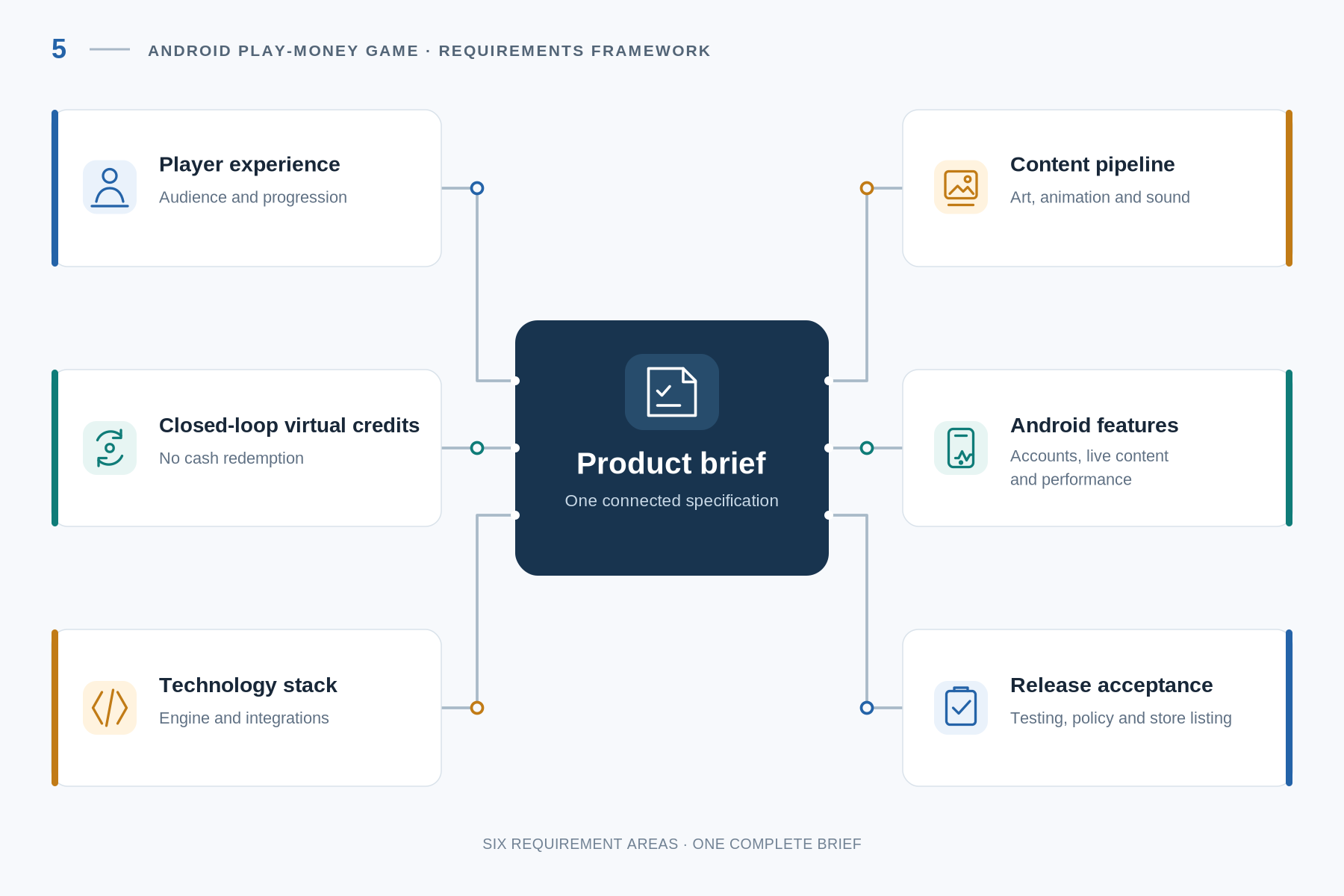
An Android slot-style game brief must define more than a theme and a set of reels. Publishers and product owners need to specify the player experience, non-redeemable virtual-credit economy, technology stack, content pipeline, Android requirements, and release acceptance criteria.
For Google Play, the product should be framed consistently as a play-money entertainment experience. Virtual credits must not be withdrawable, exchangeable for money, or presented as prizes with real-world value. This distinction should appear throughout the game design, user interface, purchase flows, marketing materials, privacy documentation, and store listing.
The following buyer guide provides a requirements framework for commissioning slot game development without drifting into real-money gambling functionality.
Define the player experience
Start with a concise product statement that tells the development team what players will see, do, and work toward. It should identify the audience, visual theme, session style, progression structure, supported orientation, and play-money boundaries.
A useful concept statement might define the product as an Android entertainment game with themed reel presentations, collectible content, short sessions, and non-redeemable virtual credits. It should not describe winnings, withdrawals, cash prizes, or connections to real-money betting services.
Themes, reels and progression loops
The theme is not merely an art direction choice. It affects symbol readability, animation scope, sound design, interface language, store assets, and the amount of content required at launch.
Define the theme using production-ready criteria:
- World and tone: For example, light fantasy, classic fruit, adventure, or stylized mythology.
- Audience suitability: State the intended age group and exclude imagery or language that would undermine the desired rating.
- Visual hierarchy: Keep essential controls, credit balances, outcomes, and prompts legible on small Android screens.
- Content breadth: Specify how many visual environments, symbol sets, characters, and collectible items are needed.
- Orientation: Choose portrait, landscape, or both based on the intended interaction and device coverage.
- Accessibility: Address text size, contrast, flashing effects, sound controls, haptics, and reduced-motion options where appropriate.
Progression gives players a reason to return without changing the product into a cash-value proposition. Suitable high-level goals can include unlocking themes, completing collections, advancing through a map, earning cosmetic upgrades, or finishing time-limited challenges.
The brief should describe the progression loop at a product level:
- The player starts a short session using virtual credits.
- Play contributes to a visible objective or collection.
- Completed objectives unlock content or virtual rewards.
- The player sees the next attainable goal.
- Progress is saved locally or to an account, depending on the account design.
Avoid leaving progression as a vague request to “improve retention.” Identify what is unlocked, how progress is communicated, and which content must be configurable after release. Detailed slot mechanics and state mapping should remain in a separate technical design specification.
Virtual credits with no cash redemption
Virtual credits should be defined as closed-loop game resources used only inside the product. They must have no cash value, no withdrawal option, and no route for transfer into money, prizes, or external betting activity.
That principle needs to be visible in both requirements and implementation:
| Requirement area | Play-money requirement |
|---|---|
| Credit balance | Displayed as an in-game resource rather than a cash account |
| Rewards | Used only for continued play, progression, or permitted virtual content |
| Redemption | No conversion into money, merchandise, prizes, or transferable value |
| Transfers | No player-to-player sale, cash-out, or external wallet connection |
| Language | Avoid claims implying income, profit, cash winnings, or guaranteed value |
| External links | Do not direct players to real-money wagering or betting services |
| Support flows | Explain virtual-credit behavior without suggesting financial ownership |
If virtual-credit packs are offered through Google Play Billing, the specification should state exactly what a purchaser receives, when the balance is delivered, and how interrupted or duplicate transactions are handled. A purchase does not change the credits into redeemable value.
The product owner should also approve a controlled vocabulary for buttons, tutorials, support articles, and promotional materials. The same play-money positioning should be used everywhere; a compliant in-game flow can still create release risk if an advertisement or store screenshot implies cash rewards.
Play-money design alone does not guarantee approval or determine legal status. Google Play policies and applicable laws can change or vary by product and market. Review the current Google Play policy guidance for real-money gambling, games, and contests and the relevant Google Play Developer Policy Center guidance before submission.
Plan the development stack
The technology decision should follow the intended content volume, visual complexity, live-update plan, team capabilities, and performance targets. It should not be based solely on the speed of an initial demo.
Unity versus 2D custom-engine trade-offs
Unity and a custom 2D implementation can both support an Android slot-style game, but they create different production and maintenance obligations.
| Decision factor | Unity | Custom 2D engine or framework |
|---|---|---|
| Prototyping | Strong editor-driven workflow and established tooling | Speed depends on existing internal tools and architecture |
| Animation | Supports complex timelines, particles, shaders, and scene composition | Can be efficient for tightly controlled 2D effects |
| Content authoring | Accessible to multidisciplinary teams using editor workflows | Often requires proprietary editors or developer assistance |
| Build size | Requires active package and asset management | May offer a smaller, more controlled runtime |
| Performance control | Broad profiling support, but configuration discipline is essential | Greater architectural control with higher engineering responsibility |
| Hiring and handover | Larger available talent pool and familiar workflows | More dependent on documentation and specialist knowledge |
| Long-term maintenance | Engine upgrades and package compatibility must be managed | Platform changes and internal tooling remain the owner’s responsibility |
Unity is often appropriate when the roadmap includes animated characters, layered effects, frequent theme production, or rapid prototyping. A custom 2D stack can suit a focused product with stable presentation requirements and a team that already owns dependable rendering, asset, billing, analytics, and Android deployment systems.
Ask prospective developers to explain:
- How configuration is separated from application code
- How new themes and events are assembled and validated
- Which Android versions and device classes are targeted
- How build size, memory use, loading time, and frame pacing are measured
- How engine and third-party dependency updates will be maintained
- What source code, tools, documentation, and licenses are included at handover
The lowest prototype estimate is not necessarily the lowest lifecycle cost. Evaluate how easily your team can operate, test, and extend the product after launch.
Art animation and sound pipeline
The content pipeline should turn approved concepts into optimized Android assets without repeated manual rework. Define responsibilities and approval gates before full production begins.
A practical pipeline includes:
- Style definition: Approve visual references, palette, interface rules, symbol silhouettes, and motion principles.
- Asset inventory: List backgrounds, symbols, interface components, effects, characters, store graphics, and promotional variants.
- Production specifications: Set dimensions, export formats, naming rules, compression methods, animation limits, and localization-safe layouts.
- Integration: Import assets into reusable templates rather than rebuilding screens for each theme.
- Review: Validate readability, animation timing, audio balance, memory use, and performance on representative devices.
- Version control: Preserve source files, exports, implementation assets, approvals, and licensing records.
Sound requirements should cover music states, interface feedback, reel and reward cues, mute controls, interruption handling, and audio behavior when the application moves into the background. The brief should also establish whether audio and animation assets are loaded at installation or delivered as optional content.
Scope Android features
Android scope should distinguish launch requirements from later enhancements. Each feature needs a user outcome, failure behavior, data dependency, and acceptance criterion—not just a name on a feature list.
Tutorial, guest account and live content
The tutorial should teach the interface and play-money nature of the experience with minimal friction. It should explain the main controls, virtual-credit balance, progression objective, sound settings, and any optional purchase flow. Define whether it can be skipped, replayed, or adapted for returning players after a major update.
Guest access can reduce onboarding friction, but the brief must explain what happens when a player changes devices, clears application data, or later creates an account. Specify:
- Whether guest progress is local, server-backed, or temporary
- How guest progress is linked or migrated to an account
- What occurs when local and cloud progress conflict
- Which recovery options are available
- How account deletion and privacy requests are handled
- Whether sign-in is optional or required for particular features
Live content should be bounded carefully. Identify which elements can change remotely, such as event schedules, banners, missions, cosmetic collections, or content availability. Then define approval, testing, rollback, and version-compatibility requirements.
Remote configuration should not become an uncontrolled substitute for release testing. Set permissions for who may publish changes, keep an audit history, validate configuration before activation, and provide safe defaults if the device cannot reach the server.
The requirements should also cover notifications, deep links, offline behavior, localization, time-zone handling, and restoration after an interrupted content download. Any live feature that collects or processes user data must be reflected accurately in the product’s privacy disclosures.
Analytics and device performance
Analytics should answer agreed product and quality questions. Start with a compact event plan rather than recording every possible interaction.
Useful event categories include:
- Tutorial start, step completion, skip, and completion
- Session start, end, duration, and return frequency
- Progression milestone and content unlock
- Virtual-credit source and use categories
- Store view, purchase initiation, success, cancellation, and failure
- Download, update, and live-content errors
- Crash, freeze, loading, and connectivity conditions
Each event should have an owner, purpose, parameter definition, and retention rule. Do not collect personal or device data merely because an analytics tool makes it available. The implementation must match the privacy policy, consent design, Google Play declarations, and applicable requirements for the intended audience and distribution markets.
Performance acceptance should use an agreed device matrix. Include lower-capability supported devices as well as common screen sizes and recent Android versions. Set project-specific thresholds for:
- Initial and repeat loading behavior
- Frame pacing during animation-heavy moments
- Peak memory use and recovery from low-memory conditions
- Application size and optional content downloads
- Battery and thermal behavior during extended sessions
- Network usage under weak or interrupted connectivity
- Interface layout across aspect ratios, cutouts, and text scaling settings
Record the test environment with each result. A performance claim is useful only when the build, device, operating-system version, network condition, and test scenario are identifiable.
Prepare release acceptance
Release acceptance converts the product brief into an objective approval decision. Assign an owner to each test area and define which failures block launch.
Gameplay, purchase and stability tests
Gameplay acceptance should confirm that the implemented experience matches the approved presentation, progression, virtual-credit rules, and content configuration. It should also test interruption and recovery rather than only ideal sessions.
Use a release checklist covering:
- [ ] Controls remain responsive during repeated and rapid interaction.
- [ ] Credit displays update accurately and cannot become inconsistent across screens.
- [ ] Progress is saved and restored according to the account specification.
- [ ] Rewards remain virtual and cannot be redeemed, transferred, or represented as cash value.
- [ ] Tutorials, settings, localization, and accessibility options work as approved.
- [ ] Backgrounding, phone calls, screen locks, and process termination do not corrupt progress.
- [ ] Offline and weak-network states produce clear, recoverable behavior.
- [ ] Live configurations fail safely when unavailable or invalid.
- [ ] Purchases use the approved Google Play flow and describe the virtual item accurately.
- [ ] Successful, cancelled, pending, duplicate, and interrupted purchase states are handled.
- [ ] Restoration and support procedures match the product specification.
- [ ] Crash, freeze, memory, battery, and thermal tests pass on the agreed device matrix.
- [ ] Analytics events fire once with the approved parameters.
- [ ] No interface, advertisement, or message implies cash prizes or withdrawal.
Define severity levels and exit criteria before testing starts. For example, the team should know whether any unresolved crash blocks release and which cosmetic defects may be scheduled for a later update. Evidence should include the build number, test case, device details, result, and linked defect.
Store-listing accuracy and age suitability
The Google Play listing is part of the product, not a separate marketing artifact. Its title, description, screenshots, video, icon, promotional text, audience declarations, data disclosures, and purchase descriptions should accurately represent the submitted build.
Before release, verify that:
- Screenshots show features and visuals actually available in the app.
- Descriptions consistently identify the experience as play-money entertainment.
- Listing language does not imply cash winnings, withdrawals, or real-world prizes.
- Age and audience declarations reflect the game’s content and presentation.
- Ads, purchases, analytics, account systems, and data practices are disclosed accurately.
- The privacy policy matches implemented collection, sharing, deletion, and contact processes.
- Customer-support details are active and operational.
- Distribution countries are approved against current platform policy and applicable requirements.
- Content ratings and questionnaires have been completed using current, accurate information.
- All current Google Play listing, age, privacy, billing, and distribution policies have been reviewed before submission.
Policies may change between planning and launch, so final compliance review should use the current Google Play Developer Policy Center rather than assumptions from an earlier project.
A concise requirements template for vendor discussions is:
| Brief field | Decision to provide |
|---|---|
| Product concept | Theme, audience, orientation, session style, and play-money positioning |
| Player experience | Reel presentation, progression objectives, collections, and unlockable content |
| Virtual credits | Sources, uses, purchase handling, and explicit non-redemption rules |
| Technology | Engine, supported Android range, integrations, and handover requirements |
| Content pipeline | Asset inventory, formats, approvals, optimization, and ownership |
| Core features | Tutorial, guest access, accounts, localization, settings, and offline behavior |
| Live operations | Remote content scope, scheduling, validation, permissions, and rollback |
| Measurement | Analytics questions, event plan, privacy controls, and reporting |
| Quality | Device matrix, performance targets, stability tests, and defect thresholds |
| Release | Billing tests, listing review, age suitability, privacy, and policy verification |
Use this template to compare proposals on implementation clarity, operating effort, compliance awareness, and release readiness—not simply headline cost.
When your concept and launch requirements are ready, request a slot game prototype proposal covering the Android stack, content pipeline, feature scope, testing plan, and play-money release boundaries.