
A launchable Android poker MVP needs more than a polished table screen. It requires a defined play-money concept, correct Texas Hold’em rules, dependable multiplayer sessions, a usable lobby, moderation controls, telemetry and measurable release criteria.
For a game studio or publisher, the key early decision is scope: identify the smallest product that proves players can understand the game, find a table, complete hands and return after a disrupted connection.
This blueprint covers a social poker product using virtual chips with no monetary value, cash prizes or withdrawal functionality. It provides a feature matrix for planning poker app development for Android from concept through launch acceptance.
Choose the poker product concept
The product concept determines the design, backend and quality-assurance workload. Before estimating delivery, document the intended audience, supported game mode, table format, session length and social features.
A concise concept statement might be:
A play-money Texas Hold’em app for Android where new players can learn through guided practice and join public multiplayer tables using virtual chips that cannot be redeemed or withdrawn.
The specification should settle these questions:
- Is the MVP primarily a practice game, a social multiplayer experience or both?
- Will tables use fixed seat counts and blind structures?
- Can players choose a table, or does matchmaking place them automatically?
- Are private tables required at launch?
- What happens when a player disconnects during a hand?
- Which communication tools are available?
- Does the product support guest play, registered accounts or both?
- Which actions can players report, mute or block?
Each answer affects multiple systems. Private tables, for example, require room creation, joining controls and invitation handling. Guest access reduces onboarding friction but creates additional identity, recovery and moderation decisions.
Single-player practice versus social tables
Single-player practice and social tables solve different product problems. Practice mode can teach controls and provide an immediately available session. Multiplayer creates the intended social experience but introduces matchmaking, networking, reconnection and player-safety requirements.
| Product dimension | Single-player practice | Social multiplayer tables |
|---|---|---|
| Primary purpose | Teach rules and table interactions | Deliver competition and social play |
| Opponents | Automated players | Connected human players |
| Availability | Immediate | Depends on active players or table seeding |
| Connectivity | Can be less dependent on continuous networking | Requires synchronized, trusted game state |
| Session handling | Pause and resume may be possible | Turns and timers continue under server rules |
| QA emphasis | Bot behavior, tutorials and rule correctness | State synchronization, disconnects and concurrency |
| Moderation | Limited | Reporting, muting and conduct controls |
| MVP value | Reduces first-session friction | Tests the core product proposition |
A studio does not necessarily need both modes in its first release. If the objective is to validate multiplayer retention and table activity, a lightweight tutorial followed by social tables may be sufficient. If the audience includes beginners or initial player liquidity is uncertain, practice play can support onboarding and remain available when public tables are quiet.
Automated opponents should not be presented as human players. The interface should identify practice sessions clearly.
Texas Hold’em gameplay and lobby essentials
The rules specification should describe the complete hand lifecycle rather than simply naming Texas Hold’em. Developers and testers need one shared definition of legal actions, transitions and outcomes.
The gameplay specification should cover:
- Player seating and virtual-chip entry requirements.
- Dealer-button and blind movement.
- Hole-card distribution.
- Pre-flop, flop, turn and river betting rounds.
- Check, call, bet, raise, fold and all-in behavior.
- Turn timers and default actions after timeout.
- Community-card dealing.
- Showdown and hand evaluation.
- Split pots, ties, main pots and side pots.
- Hand completion and preparation for the next deal.
The interface must communicate minimum and maximum raises, current commitments, remaining virtual chips, active-player status and winning hand combinations. These details prevent valid rules from becoming difficult to understand on a phone screen.
The lobby bridges opening the app and playing a hand. An MVP lobby should make tables understandable without demanding expert knowledge. Useful attributes include:
- Game mode and table name;
- Occupied and available seats;
- Blind level;
- Virtual-chip entry range;
- Table status;
- Public or private access;
- Estimated availability, where it can be supported accurately.
Filters should be limited to choices that help players enter an appropriate table. Too many similar rooms can fragment a small launch audience, while too few options can make session choice feel arbitrary.
Scope the MVP
An MVP should contain the complete path from entry to finished hand, not disconnected demonstrations of a lobby and table. This poker MVP feature matrix separates launch-critical scope from features that can usually wait.
| Area | MVP requirement | Defer unless central to the concept | Example acceptance signal |
|---|---|---|---|
| Core rules | Complete Hold’em hand flow, legal actions, showdown and pot settlement | Additional poker variants | Defined rule scenarios produce the expected result |
| Table interface | Cards, pot, virtual-chip stacks, actions, timers and player states | Elaborate themes and collectible effects | Players can identify the state and take a legal action |
| Lobby | Public-table discovery and clear table details | Advanced sorting and extensive room categories | A player can find and enter an eligible table |
| Matchmaking | Placement by table eligibility and capacity | Complex skill segmentation | Eligible players are seated without exceeding limits |
| Identity | Guest entry or a minimal account path | Broad profile customization | A new player reaches the first session with minimal friction |
| Onboarding | Contextual controls and a short tutorial | Long lesson campaigns | A first-time player can complete the initial hand |
| Connectivity | Reconnect and state restoration | Cross-device session transfer | A brief interruption does not corrupt the hand |
| Social safety | Report and mute controls, conduct workflow | Large social graphs or clubs | Reports contain enough context for review |
| Operations | Configurable table settings and service visibility | Extensive live-operations tooling | Operators can identify failures and adjust approved settings |
| Analytics | Events for onboarding, lobby, seating, hands and errors | Broad experimentation platform | The team can reconstruct the main player funnel |
| Android release | Supported-device checks and complete store package | Additional platform launches | The approved build meets release criteria |
The matrix should become a delivery artifact rather than an informal wish list. Each requirement needs an owner, dependencies and testable acceptance criteria. A feature is not complete merely because its screen exists; its gameplay, service behavior, failure handling and analytics must also work.
Table UI, virtual chips and matchmaking
A mobile poker table must present dense information without obscuring the next action. The primary hierarchy should prioritize:
- The player’s hole cards;
- Community cards;
- Current pot;
- Player stacks and hand status;
- Available actions;
- Bet or raise amount;
- Turn countdown;
- Connection and reconnect state.
Controls should prevent illegal actions instead of allowing them and returning an avoidable error. Bet controls must remain usable across supported screen sizes. Confirmation can be considered for difficult-to-reverse actions, but repeated prompts should not slow every turn.
Virtual chips need an auditable transaction history within the product’s services. Hand settlement, table entry or an approved grant should not create conflicting balances if a request is repeated. Product copy must consistently explain that the chips are for play and have no cash value or withdrawal path.
MVP matchmaking can remain straightforward: place an eligible player at a compatible table with an available seat. The logic should handle several users requesting the last seat and cases where a selected table becomes unavailable before joining completes. If placement fails, the app should return the player to a useful state rather than showing an indefinite loading indicator.
Guest entry, tutorial and moderation
Guest entry can shorten the route to the first hand, but it needs defined lifecycle rules. The specification should state how a guest identity is created, what data is retained, whether progress can be associated with a registered profile and what happens after reinstalling the app or changing devices.
A focused tutorial should teach actions in context:
- Identify hole cards and community cards.
- Explain whose turn it is.
- Demonstrate check, call, raise and fold.
- Clarify the pot and virtual-chip commitments.
- Show the result and winning hand.
- Lead the player into practice or a public table.
Moderation is part of MVP scope whenever users can communicate or name themselves. Controls may include muting chat, reporting a player, filtering prohibited text and reviewing session context. Reports should carry structured information—such as table, hand or message context—so an operator can investigate without relying only on free-form descriptions.
The app can acknowledge receipt of a report without exposing internal moderation details or promising an outcome that the evidence cannot support.
Design the architecture
The architecture should protect rule execution and session continuity while keeping the Android client responsive. The central principle is straightforward: the client presents the game and requests actions, while trusted services determine whether those actions are legal and advance the hand.
Architecture should follow confirmed scope. A practice-only prototype does not need the same service footprint as public multiplayer tables, while a social launch cannot treat reconnection and duplicate requests as optional edge cases.
Authoritative gameplay state and reconnects
In multiplayer, the Android client should not be the source of truth for card dealing, legal moves, turn order, pot settlement or virtual-chip balances. An authoritative gameplay service should validate requests and publish the resulting state.
A typical action sequence is:
- The client submits an intended action for the current hand and turn.
- The gameplay service confirms that the player, table and action are valid.
- The service updates the trusted hand state.
- The resulting state is sent to participants.
- Each client renders the state and requests recovery if needed.
This model reduces disagreement between devices, makes rule failures easier to investigate and protects against repeated submissions caused by retries or unstable connectivity.
Reconnection needs explicit product behavior. When a device loses connectivity, the interface should indicate the interruption, attempt recovery and request a current state snapshot. The restored view must show the actual cards, pot, commitments, timers and player status rather than assumptions stored only on the device.
Acceptance scenarios should include disconnecting before an action, during an action request, after the service accepts an action and during settlement. Server-controlled timeouts should prevent a disconnected player from pausing a public table indefinitely.
Telemetry and mobile client services
Telemetry should show whether players can move through the core funnel and where the build fails. Useful event groups include:
- App start and version;
- Guest or account entry;
- Tutorial start, step and completion;
- Lobby view and table selection;
- Matchmaking request and result;
- Seat attempt and outcome;
- Hand start and completion;
- Player action and validation failure;
- Disconnect, reconnect attempt and recovery;
- Client or service error category;
- Report or mute action.
Analytics should avoid unnecessary personal or sensitive information. Event definitions, retention, access and disclosures should be reviewed as part of privacy work rather than added after implementation.
The Android client also needs configuration handling, crash reporting, version compatibility checks and controlled maintenance messaging. These services should fail safely. If an installed version cannot participate in the current protocol, the app should explain the required next step instead of allowing entry into a session that cannot function.
Validate a launch-ready build
A launch decision should be based on agreed evidence, not the absence of newly reported bugs. The studio, publisher and development partner should define pass/fail criteria during planning and update them when scope changes.
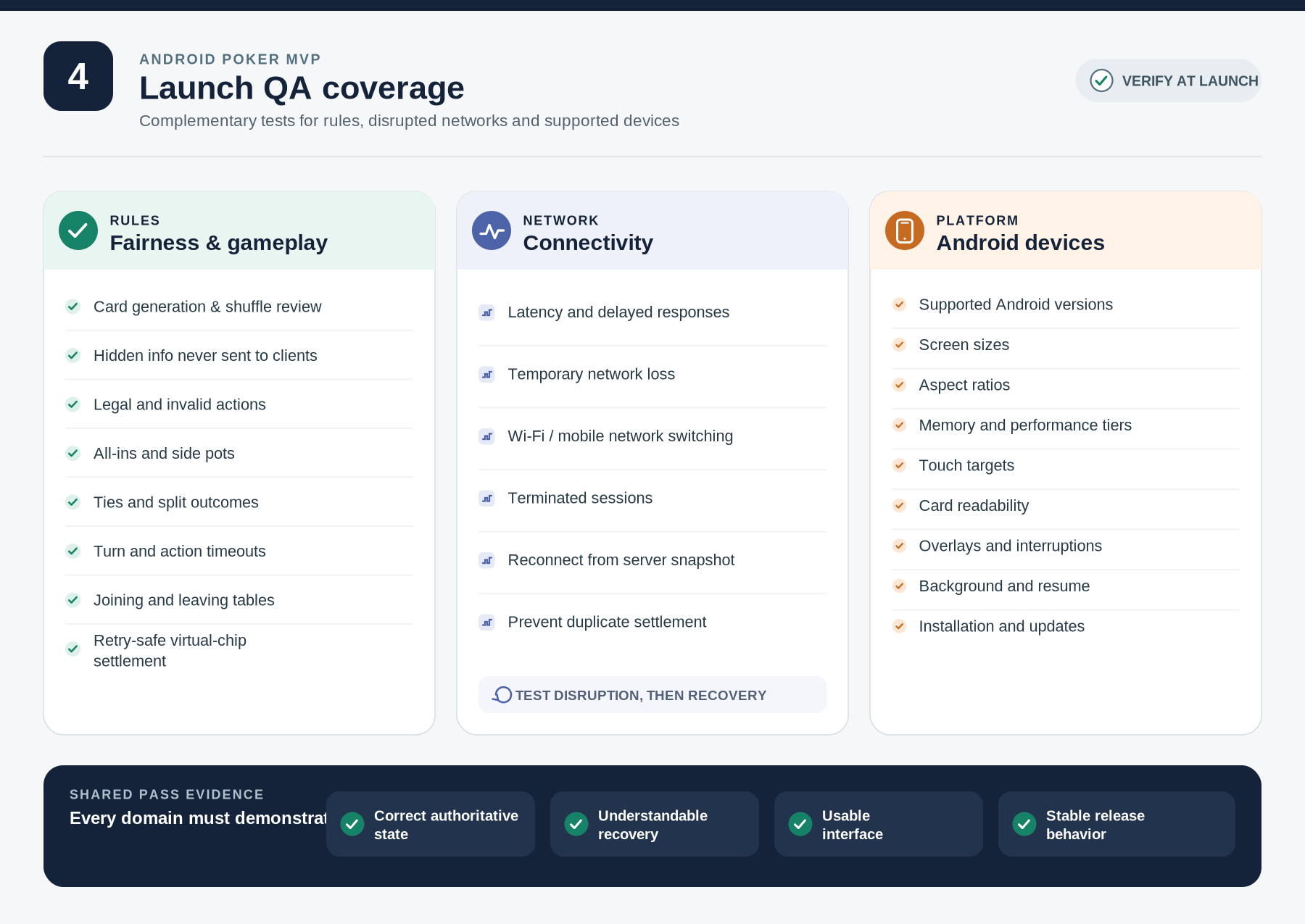
The final candidate should demonstrate four outcomes:
- Hold’em rules resolve correctly across documented scenarios.
- Multiplayer sessions remain consistent during normal and disrupted play.
- The interface works across the approved Android device range.
- Store materials, disclosures and policy reviews match the released product.
Fairness, connectivity and device QA
Fairness testing should verify the implementation rather than make unsupported claims about outcomes. The team should review card generation and shuffling behavior, prevent clients from controlling hidden information and test hand evaluation against documented scenarios.
Gameplay QA should include:
- Every supported action at each betting stage;
- Invalid, late and repeated action requests;
- All-in situations and side pots;
- Ties and split-pot settlement;
- Turn timeout and inactive-player behavior;
- Players joining, leaving and reconnecting;
- Table closure and service maintenance behavior;
- Consistent virtual-chip settlement after retries.
Connectivity tests should simulate latency, temporary loss, network switching and terminated app sessions. The goal is not to make every interruption invisible. It is to preserve correct state, provide understandable recovery and prevent a hand or balance from being settled twice.
Device QA should cover the supported Android versions, screen sizes, aspect ratios, memory profiles and performance tiers. Testers should check touch targets, card readability, overlays, system interruptions, backgrounding, resume behavior, installation, updates and fresh-start flows.
Play Store assets and acceptance criteria
The Google Play listing must accurately represent a play-money social poker product. Store copy and screenshots should not suggest cash prizes, withdrawal or access to real-money betting. The release package should include the required listing materials, accurate content declarations, privacy information and support details applicable to the product and distribution plan.
Google Play requirements can change. Before submission, verify the current versions of the supplied official references:
- Google Play policy reference for gambling, games and contests
- Google Play policy reference for release review
The publisher should confirm current listing, age-rating, privacy and distribution requirements in Google Play’s official documentation and console. Review should occur before publication and again before launch, especially if functionality, territories, user communication or data practices change.
A practical launch checklist is:
- [ ] Approved Texas Hold’em rule scenarios pass.
- [ ] Illegal and duplicate actions do not corrupt game state.
- [ ] Reconnection restores the authoritative table state.
- [ ] Virtual chips are presented as having no monetary value.
- [ ] Guest, tutorial, lobby and first-hand flows meet acceptance criteria.
- [ ] Reporting and muting work wherever relevant interaction exists.
- [ ] Telemetry covers the core funnel and operational failures.
- [ ] Supported Android devices pass usability and stability testing.
- [ ] Store copy and assets match the build.
- [ ] Privacy, content, age and distribution declarations are current.
- [ ] No content implies prizes, withdrawal or real-money betting.
- [ ] Release ownership, rollback handling and support workflows are assigned.
The result is a focused Android poker MVP with a complete player journey and a scope that can be estimated, tested and accepted. Studios can then use product evidence to prioritize later expansion instead of loading unvalidated features into the first release.
Ready to turn this blueprint into a delivery scope? Discuss a poker game MVP with a poker game development team.